AI Appraisal Estimate

AI-generated estimates · not official valuations

From the user

What was submitted

Photo and notes provided by the user — not generated by AI

Submitted item photo
Submitted photo · May 23, 2026

User's notes

No additional notes provided.

AI analysis below

AI appraisal

AI analysis & estimate

AI-Generated · Verify before acting

Everything below is generated by AI for informational purposes only. AI can make mistakes — the AI may misidentify items or misattribute them (artist, maker, brand, designer, origin, era). This is not an official valuation and should not be used for insurance, sale, tax, estate, legal, or lending purposes — or any decision requiring a certified appraisal. It is not an authoritative claim about any person, brand, or rights holder — do not share or rely on it as a factual statement about a third party. Always consult qualified professionals before making financial decisions.

Read the full disclaimer

AI Identification

·Not independently authenticated·Verify before acting

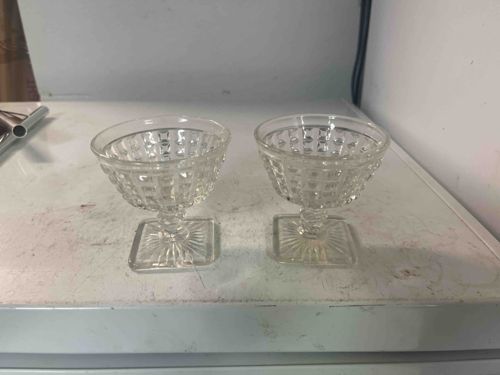
Pair of Depression-Era Cube Pattern Pressed Glass Pedestal Sherbet Cups

Vintage Glassware / Kitchenalia

AI Estimated Value

·Not an official valuation·Verify before acting

$15.00 - $25.00

As of May 23, 2026

AI Item Analysis

·AI can make mistakes·Verify before acting
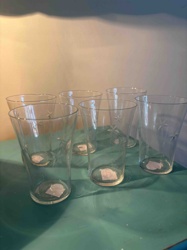
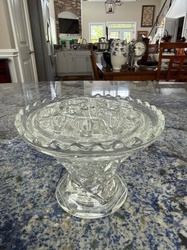
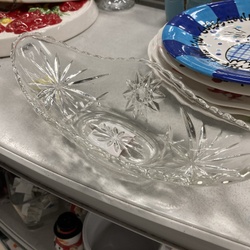
This is a matching pair of clear pressed glass pedestal sherbet or dessert cups, likely dating from the Depression-era (1920s-1940s). The vessels feature a prominent 'Cube' or 'English Hobnail' style pattern, characterized by a repeating geometric grid of raised squares covering the exterior of the bowl. The bowls are conical/flared in shape with a smooth upper rim. Each sits atop a short, faceted pedestal stem that joins to a distinct square-shaped base. The bases are particularly notable for their underside molded starburst or sunburst pattern, which provides both visual interest and structural stability. The glass exhibits a high degree of clarity with a slight internal brilliance characteristic of sodium-lime glass of that period. Physically, they appear to be approximately 3 to 4 inches in height. There are no immediate signs of large chips or cracks visible, though such items frequently show minor 'flea bites' around the sharp edges of the cube pattern or the base corners. The molding lines are visible, indicating they were mass-produced in metal molds. No specific maker's marks are visible in the image, but the style is highly consistent with manufacturers such as Jeanette, Hazel-Atlas, or Imperial Glass, known for their utilitarian yet decorative tableware during the early-to-mid 20th century.
AI Appraisal Report

·AI can make mistakes·Verify before acting
I have conducted a visual examination of this pair of Depression-era pedestaled sherbet cups. The items feature the 'Cube' pattern, a geometric design popularized by manufacturers such as Jeanette Glass (specifically their 'Cube' or 'Cubist' lines produced circa 1929–1933). The clear glass demonstrates the expected mold lines and the characteristic square base with a starburst underside, confirming they are consistent with mass-produced American kitchenware of the early 20th century. Condition-wise, the glass maintains good clarity without evidence of 'sick' glass (permanent clouding). While no major fractures are visible, these pressed patterns are notoriously prone to 'flea bites' or micro-chipping on the sharp facets of the cubes and the corners of the square base. The value remains modest due to the high production volume of the era and the current market saturation for clear Depression glass, which generally commands lower prices than colored counterparts like pink or green. Market demand for clear 'utility' glass is stable but low, primarily driven by replacement buyers or collectors of 'Cubist' patterns. Comparable sales for a pair typically fall in the $15 to $25 range. Limitations: My assessment is Based on digital images. A definitive valuation and authentication would require an in-person inspection to verify the presence of internal heat checks, feel for rough edges, and check for fluorescence under UV light, which helps distinguish original Depression glass from late 20th-century reproductions. Documentation of provenance, such as original box or family history, would further support the dating but would not significantly shift the market value for these specific utilitarian pieces.

Get your items appraised

Instant estimates of your treasures with AI-powered appraisals

Browse More Appraisals