AI estimate as of October 30, 2025 · verify with a professional before acting
AI-Generated · Verify before acting
Everything on this page is generated by AI for informational purposes only. AI can make mistakes — the AI may misidentify items or misattribute them (artist, maker, brand, designer, origin, era). This is not an official valuation and should not be used for insurance, sale, tax, estate, legal, or lending purposes — or any decision requiring a certified appraisal. It is not an authoritative claim about any person, brand, or rights holder — do not share or rely on it as a factual statement about a third party. Always consult qualified professionals before making financial decisions.
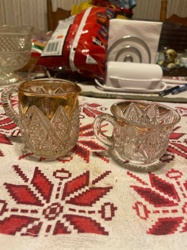
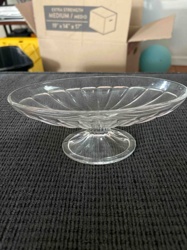
This appears to be a clear cut glass snack or dessert plate, possibly part of a larger serving set. Its physical characteristics include transparent glass, meticulously cut with a variety of starburst and geometric patterns that create a highly reflective and decorative surface. The plate has a circular form, with a scalloped or undulating rim that adds a graceful, decorative edge. The central portion features a series of interconnected diamond shapes, each enclosing a starburst pattern composed of multiple rays. Surrounding this central motif, the plate is adorned with larger, more prominent starbursts, some appearing as multi-pointed stars, showcasing impressive craftsmanship in glass cutting. The depth and precision of the cuts suggest it might be lead crystal, known for its brilliance and light-refracting properties, though a definitive identification would require closer inspection or a chemical test. There are no visible chips, cracks, or significant abrasions from the provided image, suggesting good to very good overall condition. As there are no discernible maker's marks or signatures visible, its exact manufacturing origin and age are difficult to pinpoint. However, similar patterns were popular during the early to mid-20th century, particularly in the American Brilliant Cut Glass era or subsequent Depression-era glass productions. The quality of the cuts indicates a piece designed for aesthetic appeal and light play, making it suitable for elegant serving or display. The plate exemplifies a classical style of glass artwork, emphasizing intricate detail and sparkling effects.
AI Appraisal Report
Upon visual examination of the provided image, this cut glass snack or dessert plate presents as a beautifully crafted piece, likely lead crystal due to the apparent brilliance and intricate cutting, although this cannot be definitively confirmed without physical inspection or a lead content test. The condition appears to be good to very good; I observe no visible chips, cracks, or significant abrasions in the image, which is a key factor in its market appeal. The meticulously cut starburst and geometric patterns, along with the scalloped rim, suggest a high level of craftsmanship. The design is indicative of styles popular during the American Brilliant Cut Glass era (late 19th to early 20th century) or possibly a slightly later Depression-era piece of higher quality. Without a maker's mark or definitive provenance, pinpointing the exact manufacturer and age is challenging. Market conditions for cut glass of this type are generally stable, with demand varying based on design intricacy, condition, and rarity. While intricate, patterns similar to this were produced in volume, making this particular plate not exceptionally rare as a standalone item, though it might be rarer if part of a complete, intact set. Factors significantly impacting value include the excellent condition and the quality of the cutting. However, the lack of a known maker, provenance, and the potential for it being a mass-produced item from a later period without the premium associated with earlier, hand-finished pieces, temper its overall value. For full authentication regarding its age, material (lead crystal vs. pressed glass), and maker, an in-person examination, potentially including a spectrographic analysis for lead content and thorough search for very faint maker's marks, would be essential.