AI estimate as of October 12, 2025 · verify with a professional before acting
AI-Generated · Verify before acting
Everything on this page is generated by AI for informational purposes only. AI can make mistakes — the AI may misidentify items or misattribute them (artist, maker, brand, designer, origin, era). This is not an official valuation and should not be used for insurance, sale, tax, estate, legal, or lending purposes — or any decision requiring a certified appraisal. It is not an authoritative claim about any person, brand, or rights holder — do not share or rely on it as a factual statement about a third party. Always consult qualified professionals before making financial decisions.
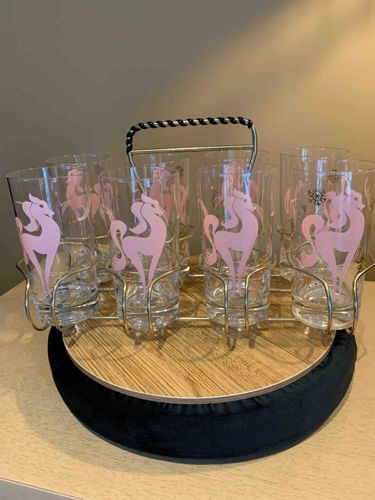
This item is a set of eight vintage glass tumblers, each adorned with a stylized pink unicorn design. The tumblers appear to be made of clear glass, likely soda-lime glass, with a smooth, cylindrical shape, tapering slightly towards the bottom. The unicorn motif is prominently featured on one side of each glass, rendered in a solid, opaque pastel pink color. The unicorn is depicted in a rearing or prancing pose, with flowing mane and tail, and a single horn. The artwork style suggests a mid-20th-century aesthetic, possibly from the 1950s or 1960s, a period known for playful and whimsical designs on glassware. The set is housed in a circular caddy, which features a light-colored wooden base with a visible wood grain, possibly oak or a similar light-toned wood. The base appears to be mounted on a dark, possibly black or very dark blue, semicircular cushioned support, which might be velvet or a similar soft fabric, designed to prevent scratching surfaces. The glasses are held in place by a brass-toned or gold-toned wire frame caddy that securely grips each tumbler. The caddy has a central handle with a twisted, possibly Bakelite or plastic, grip in alternating black and white or black and clear segments, providing a comfortable and stylish way to transport the set. One of the glasses has a faint snowflake-like design near the unicorn, but this detail is only clearly visible on one glass, suggesting it might be an anomaly or a variation within the set. The overall condition appears good, with no visible chips or cracks on the glass tumblers. The pink unicorn decals show good adhesion with no significant fading or peeling. The metal caddy seems structurally sound, and the wooden base and cushioned support appear to be in good condition. The craftsmanship is typical of mass-produced glassware from its era, focusing on decorative appeal.
AI Appraisal Report
Upon visual examination of this Vintage Pink Unicorn Glass Tumbler Set with Caddy, I can confirm it is a charming example of mid-20th-century decorative glassware, likely dating to the 1950s or 1960s. The set includes eight tumblers with a stylized pink unicorn decal, housed in a mixed-material caddy featuring a wooden base, a cushioned support, a wire frame, and a central plastic handle. The overall condition appears to be very good for its age, with no visible chips or cracks in the glass. The unicorn transfers seem well-adhered and vibrant, which is a significant value-preserving factor, as peeling or faded decals are common issues. The brass-toned caddy and its components also appear intact and functional.
From a market perspective, comparable mid-century glassware sets with whimsical motifs are quite popular, appealing to collectors of vintage barware and kitsch decor. Sets complete with their original caddy command higher prices. Current market listings for similar 8-glass tumbler sets from this era, complete with a caddy, typically range from $60 to over $100, depending on the rarity of the pattern, maker, and condition. The unicorn motif is particularly desirable and on-trend, which increases its appeal. The anomaly of a snowflake-like design on one glass is likely a production flaw and does not significantly impact value, but may be of interest to some collectors.
However, this appraisal is based solely on images. Full authentication requires in-person examination to verify the maker's marks (if any, often on the glass bottom), confirm the materials (e.g., Bakelite vs. other plastics), and assess the decal quality and any hidden damage not visible in photos. Without such inspection, the maker and precise origin remain unconfirmed.