AI estimate as of September 12, 2025 · verify with a professional before acting
AI-Generated · Verify before acting
Everything on this page is generated by AI for informational purposes only. AI can make mistakes — the AI may misidentify items or misattribute them (artist, maker, brand, designer, origin, era). This is not an official valuation and should not be used for insurance, sale, tax, estate, legal, or lending purposes — or any decision requiring a certified appraisal. It is not an authoritative claim about any person, brand, or rights holder — do not share or rely on it as a factual statement about a third party. Always consult qualified professionals before making financial decisions.
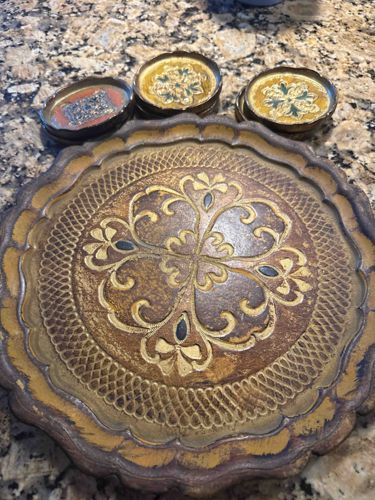
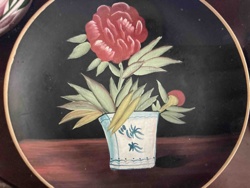
This set consists of a large, circular, heavily embossed and hand-painted toleware serving tray accompanied by three matching circular coasters. The overall aesthetic is rustic and ornate, characteristic of Italian toleware from the mid-20th century. The tray features a scalloped edge creating a decorative border, approximately 0.5 inches thick, painted in a dark, possibly distressed bronze or brown color with hints of antique gold. The main surface of the tray is dominated by an elaborate central design of swirling acanthus leaves and floral motifs, executed in gold and lighter brown tones, with subtle accents of dark blue or black in the negative spaces, set against a warm, earthy brown background. Surrounding this central medallion is a textured band resembling a wicker or basketweave pattern, also highlighted with gold. The entire surface exhibits a considerable amount of wear, particularly to the raised gold areas and edges, revealing the darker base material beneath. There are visible scratches, scuffs, and areas of paint loss, consistent with age and use. The construction appears to be lightweight metal, likely tin or iron, shaped and then painted. The three visible coasters mirror the design elements of the tray, featuring the same scalloped edge and central floral-like pattern, though with a different arrangement (one coaster has a distinct, smaller, more geometric pattern visible). These also show similar signs of wear and patination, suggesting they are original to the tray. The reverse of one coaster appears to be a solid color, possibly a salmon or rust, with an unidentifiable textured pattern. The craftsmanship, while appearing mass-produced, still showcases attention to detail in the decorative painting and embossing, aiming for an antique or hand-crafted feel. The patina and wear contribute to its vintage charm, rather than detracting significantly from its decorative appeal.
AI Appraisal Report
Based on my visual examination of the provided image, I assess this Vintage Italian Toleware Hand-Painted Serving Tray with Coasters as a genuine example of mid-20th century Italian toleware. The aesthetic, characterized by its heavily embossed, hand-painted floral and acanthus motifs, scalloped edges, and rustic finish, is consistent with typical Italian decorative wares from that period. The construction appears to be lightweight metal, likely tin, which is standard for toleware. The condition exhibits significant wear, including paint loss, scratches, and scuffs, particularly on raised gold areas. While this indicates substantial use and age, it also contributes to its vintage charm rather than severely diminishing its decorative appeal for collectors of such items.
In terms of market conditions, Italian toleware from this era typically falls into the decorative arts category, with a steady but not exceptionally high demand. Comparables for similar vintage Italian toleware trays with matching coasters often range from $60 to $150, depending on size, condition, and intricacy of design. The inclusion of three matching coasters adds value. This item is not particularly rare; however, well-preserved sets are becoming less common. The primary factors impacting value are its decorative appeal, the completeness of the set, and the extent of wear. My valuation reflects its current condition and decorative nature.
It is crucial to note that my assessment of authenticity is based solely on visual inspection of the image. For full authentication, an in-person examination would be necessary to physically assess the materials, craftsmanship, weight, and reverse markings. Provenance documentation, such as original sales receipts or family history, would also provide stronger verification of its origin and age. Scientific testing, such as paint analysis, is typically not warranted for items in this price range but could confirm period-appropriate materials if authenticity were heavily disputed.