These notes were written by the person who submitted this item. Appraiser.AI has not verified them, and the AI's identification and estimate may rely on them.
AI Estimated Value
Not an official valuation
$40-80
AI estimate as of July 17, 2025 · verify with a professional before acting
AI-Generated · Verify before acting
Everything on this page is generated by AI for informational purposes only. AI can make mistakes — the AI may misidentify items or misattribute them (artist, maker, brand, designer, origin, era). This is not an official valuation and should not be used for insurance, sale, tax, estate, legal, or lending purposes — or any decision requiring a certified appraisal. It is not an authoritative claim about any person, brand, or rights holder — do not share or rely on it as a factual statement about a third party. Always consult qualified professionals before making financial decisions.
This analysis also relies on unverified notes provided by the user, which may be incomplete or inaccurate and could affect the result.
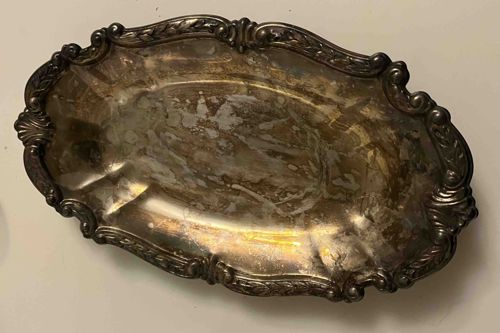
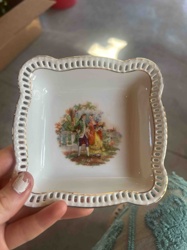
This item is an ornate, oblong serving tray or dish, likely crafted from silver-plated metal, given its characteristic luster and visible tarnishing patterns. The tray features a scalloped, serpentine rim adorned with richly detailed rococo-inspired scrollwork and foliage motifs, particularly prominent at the corners where the curves are most pronounced. The overall shape is irregular and organic, typical of late 19th to early 20th-century decorative pieces designed to evoke grandeur and elegance. The material appears to be a metal, exhibiting a metallic silver sheen beneath areas of significant tarnish, which manifests as patchy, dark gray to brown discolorations, especially concentrated in the recessed areas and center of the well. This tarnish indicates minimal recent cleaning and suggests an older age or prolonged storage. There are visible signs of wear, including scratches and abrasions on the reflective surface of the well, consistent with regular use over time. Some areas of the silver plating may also show minor loss or thinning, contributing to the mottled appearance. There are no clearly discernible maker's marks, signatures, or stamps visible in the provided images, which would typically be found on the underside. The craftsmanship reflects a decorative approach, focusing on elaborate surface ornamentation rather than minimalist design. The depth of the well suggests it could hold various items, such as candies, nuts, or small serving pieces. The quality of the casting or stamping for the decorative rim appears to be good, with intricate details still evident despite the surface condition. The exact size is not provided, but it appears to be a medium-sized tray, appropriate for a centerpiece or small serving accessory. The 'Sheridan' context provided might hint at a brand, a pattern name, or the previous owner, but without visible marks, it remains speculative.
AI Appraisal Report
Based on my visual examination of the provided image, this ornate silver-plated serving tray exhibits characteristic luster and tarnishing patterns consistent with its description. The rococo-inspired scrollwork and foliage motifs indicate a late 19th to early 20th-century decorative style, likely mass-produced. Its condition, as described, shows significant tarnish, scratches, and abrasions, alongside potential loss of plating, which are typical signs of age and considerable use. The absence of visible maker's marks is a significant limitation; while 'Sheridan' is mentioned, without a physical mark, this remains speculative and does not confirm authorship.
In terms of market conditions, decorative silver-plated trays from this period, especially unmarked ones and those in less-than-pristine condition, generally fall into a modest demand category. Comparables often sell in the antique or vintage home decor market rather than fine art or high-end collectibles. The value is primarily driven by aesthetic appeal as a decorative object rather than historical significance or provenance, which cannot be established here. Its utility as a serving piece is secondary to its ornamental function. Factors impacting value negatively include the extensive tarnish, wear, and lack of clear maker's marks.
Limitations in authenticity verification are substantial. Without an in-person examination, I cannot definitively determine the metal composition (e.g., solid silver vs. plate), assess the extent of plating loss, or find any hidden maker's marks. A physical inspection would be crucial for precise condition assessment and to search for marks under magnification. Scientific testing, like XRF analysis, would confirm metal composition. Provenance documentation, if available, could link it to the 'Sheridan' name or a known collection, significantly enhancing its historical context and potential value.