These notes were written by the person who submitted this item. Appraiser.AI has not verified them, and the AI's identification and estimate may rely on them.
AI Estimated Value
Not an official valuation
$40-70
AI estimate as of September 21, 2025 · verify with a professional before acting
AI-Generated · Verify before acting
Everything on this page is generated by AI for informational purposes only. AI can make mistakes — the AI may misidentify items or misattribute them (artist, maker, brand, designer, origin, era). This is not an official valuation and should not be used for insurance, sale, tax, estate, legal, or lending purposes — or any decision requiring a certified appraisal. It is not an authoritative claim about any person, brand, or rights holder — do not share or rely on it as a factual statement about a third party. Always consult qualified professionals before making financial decisions.
This analysis also relies on unverified notes provided by the user, which may be incomplete or inaccurate and could affect the result.
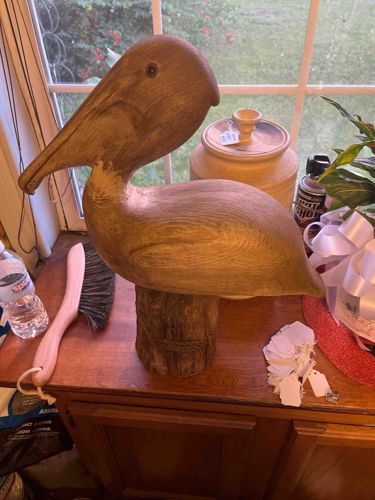
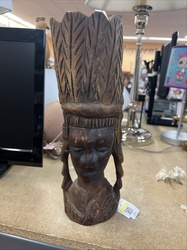
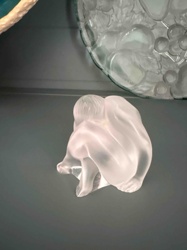
This is a hand-carved wooden figurine depicting a pelican, mounted on a solid, rustic base, likely a piece of a tree branch or trunk. The pelican itself exhibits a smooth, weathered-looking finish, suggesting either a natural aging process or an intentional antiqued treatment. Its color is a rich, warm brown, with visible wood grain patterns throughout the body, head, and long, distinctive beak. The eyes are represented by small, dark, possibly inlaid, circular pieces set into the head. The carving style appears to be somewhat stylized yet captures the essential form of a pelican with its characteristic long bill and a pouch indicated by the slight curve beneath the beak. The body is plump and rounded, smoothly transitioning into a gracefully curved neck. The carving shows a moderate level of detail, emphasizing the bird's silhouette rather than intricate feathering. The base is irregular and organic, presenting a naturalistic foundation for the sculpture. A notable condition issue is a repair at the neck, where the wood has been glued back together. This repair is visible as a lighter, possibly slightly uneven line or area where adhesive may have seeped or discolored the wood. The overall craftsmanship suggests a folk art or decorative piece, possibly from the mid to late 20th century, designed for display in a coastal or rustic-themed home. The quality is decent for a decorative folk art item, with manual carving evident in the slight imperfections and unique shaping. No specific maker's marks or signatures are discernible from the provided images.
AI Appraisal Report
I have examined the provided image and details for this carved wooden pelican figurine. The item presents as a hand-carved piece, likely folk art, with a warm brown finish and visible wood grain, consistent with a decorative object from the mid to late 20th century. The carving style is stylized, effectively capturing the pelican's form, and the irregular base adds to its naturalistic appeal.
My assessment of its condition notes a significant repair: the wood has been glued back together at the neck. This repair is a notable detraction, impacting both aesthetics and structural integrity, and will reduce its market value. The smooth, weathered finish appears intentional or a result of natural aging, but the repair introduces a visible imperfection.
Regarding authenticity, based solely on images, I can confirm it appears to be a genuine hand-carved wooden figurine. However, without in-person examination, I cannot definitively verify the type of wood, the exact age, or rule out machine assistance in basic shaping before hand-finishing. Provenance documentation could offer insight into its origin and maker, which is currently unknown due to the absence of discernible marks.
Market conditions for decorative folk art, especially pieces with condition issues, can be modest. Comparables typically sell in a range depending on size, intricacy, and condition. The repair significantly affects demand, as collectors generally prefer pieces in original, undamaged condition. While charming, its rarity is not exceptional, as similar decorative wooden birds are relatively common. The primary factor impacting value here is the visible repair at the neck. Without this damage, the value would be higher. Therefore, considering the repair, the estimated appraisal value reflects its current condition and decorative appeal within the secondary market. Physical inspection would allow for a closer look at the repair quality and wood properties.