AI estimate as of September 25, 2025 · verify with a professional before acting
AI-Generated · Verify before acting
Everything on this page is generated by AI for informational purposes only. AI can make mistakes — the AI may misidentify items or misattribute them (artist, maker, brand, designer, origin, era). This is not an official valuation and should not be used for insurance, sale, tax, estate, legal, or lending purposes — or any decision requiring a certified appraisal. It is not an authoritative claim about any person, brand, or rights holder — do not share or rely on it as a factual statement about a third party. Always consult qualified professionals before making financial decisions.
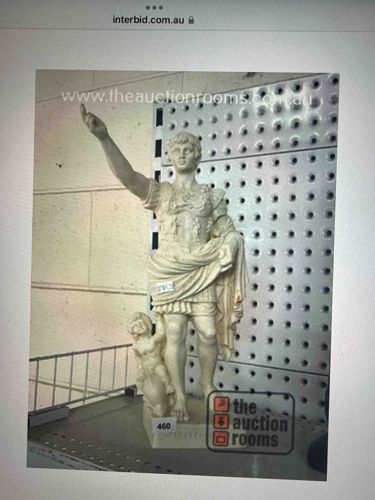
This item is a decorative replica statue, clearly inspired by the iconic 'Augustus of Prima Porta' Roman marble sculpture. The statue depicts a male figure, likely a Roman emperor, standing in a contrapposto pose with his right arm raised, pointing forward, and his left arm holding draped fabric. He is clad in elaborate military armor over a tunic, with highly detailed imagery molded onto the breastplate, though specific scenes are not entirely clear from the image. The armor design includes mythological or allegorical figures. A draped toga or cloak is wrapped around his waist and legs, adding to the classical aesthetic. A smaller, nude figure, possibly Cupid riding a dolphin (a common attribute of Augustus), is positioned near his right leg, serving as a support and a symbolic element due to Augustus's claimed lineage from Venus. The statue appears to be made from a light-colored, possibly off-white or cream, cast material such as resin, plaster, or a composite stone, giving it a faux marble or aged stone appearance. The surface shows a relatively smooth finish with some visible texture, suggesting it is not finely carved marble but rather a manufactured piece. Its overall condition seems good, with no obvious signs of significant damage like chips, cracks, or repairs visible in the provided image. The color is uniform, lacking any pronounced patina that would suggest genuine age or weathering. The craftsmanship appears to be of a reasonable decorative quality, replicating the classical form and details, but without the nuanced artistry of an original sculpture. The base is an integral part of the statue, a rectangular plinth providing stability. Given its likely material and detailed reproduction, it most likely dates from the 20th or 21st century, designed for decorative purposes rather than as an ancient artifact. A white sticker with '460' is visible on the base, likely an inventory or lot number.
AI Appraisal Report
I have examined the provided image of the Augustus of Prima Porta Replica Statue. My assessment indicates a modern decorative piece, clearly inspired by the iconic Roman sculpture. Its material appears to be a cast composite, likely resin or plaster, given the smooth finish and uniform, light color, mimicking faux marble. The condition appears good, with no visible damage such as chips or cracks in the image. This is a factory-produced replica, not an ancient artifact, authenticated by its material, casting method, and general lack of genuine ancient patina or wear. The visible '460' sticker further supports its modern inventory origin.
Market conditions for such decorative replicas are driven by aesthetic appeal and size. Comparables, typically found in home decor stores or online retailers, range from inexpensive novelty items to more detailed, larger statues. While this piece offers good detail, its material limits its value. Demand for classical statuary in home decor is steady but not particularly high for reproductions of this quality, and such items are not rare.
Factors significantly impacting value are its decorative nature, modern material, and the fact it is a mass-produced replica rather than a unique artwork or antique. Reproductions like this generally hold value as decorative items.
Limitations in authenticity verification are significant based on images alone. A physical inspection would be crucial to definitively identify the exact material (e.g., distinguishing between plaster, resin, or genuine reconstituted stone), assess its precise weight, and examine the underside for maker's marks or further provenance information. It would also allow for a tactile assessment of surface quality and confirmation of structural integrity. Without physical examination, precise dating beyond '20th-21st century' is impossible, and any specific claims of origin or artist are unsubstantiated.