AI estimate as of August 26, 2025 · verify with a professional before acting
AI-Generated · Verify before acting
Everything on this page is generated by AI for informational purposes only. AI can make mistakes — the AI may misidentify items or misattribute them (artist, maker, brand, designer, origin, era). This is not an official valuation and should not be used for insurance, sale, tax, estate, legal, or lending purposes — or any decision requiring a certified appraisal. It is not an authoritative claim about any person, brand, or rights holder — do not share or rely on it as a factual statement about a third party. Always consult qualified professionals before making financial decisions.
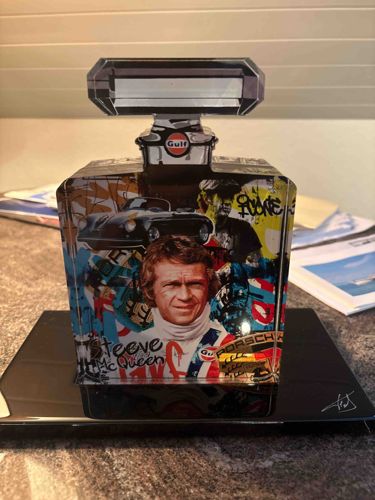
This appears to be a mixed-media sculpture or decorative object, designed to resemble a stylized perfume bottle or decanter, heavily themed around automotive racing culture and the iconic figure of Steve McQueen. The main body of the object is cuboid, seemingly constructed from a rigid material like wood or resin, covered with a collaged or printed surface. This surface features a vibrant, pop-art inspired aesthetic, with images of classic cars, possibly a Porsche 911, and prominent text elements like "Steve McQueen" in red script. A large, clear image of Steve McQueen's face, wearing racing attire, is central to the design. Other visible elements include graffiti-style text, various abstract shapes, and perhaps other automotive-related motifs. The color palette is diverse, incorporating blues, reds, yellows, and black, against a generally light background.
The 'stopper' of this 'bottle' is a multi-faceted, geometric shape, likely made of a clear or translucent material, possibly acrylic or glass, with a metallic silver-colored band around its base. Directly below the stopper, an orange circular 'Gulf' logo is prominently displayed, associating the piece directly with Gulf Oil's iconic motorsports livery. The entire piece rests on a flat, rectangular black base, which appears to be glossy, possibly made of black acrylic or obsidian. There are no obvious visible condition issues such as scuffs, scratches, or wear, suggesting it is either new or well-maintained. The craftsmanship appears to be of good quality, with clear printing and seemingly precise assembly. The style suggests a modern, contemporary design, likely produced in the late 20th or early 21st century, capitalizing on the enduring appeal of Steve McQueen and vintage racing. The absence of specific maker's marks or signatures on the visible surfaces, other than what appears to be a stylized signature on the black base, limits the ability to pinpoint a specific artist or manufacturer without further investigation, though it is consistent with limited edition art pieces.
AI Appraisal Report
Upon visual examination of the provided image, this Steve McQueen Gulf Racing Pop Art Sculpture appears to be in excellent condition, showing no discernible scuffs, scratches, or wear. Its authenticity, based solely on visual cues, points to a commercial art piece rather than a unique fine art sculpture, likely produced to capitalize on the iconic imagery of Steve McQueen and Gulf Racing. The crispness of the graphics and assembly suggest modern manufacturing. Market conditions for such pop culture-inspired decorative art are robust among automotive enthusiasts and collectors of movie memorabilia. Comparable items, often sold through online art and collectible platforms, range widely depending on artist recognition and edition size. The demand for items featuring Steve McQueen and the Gulf livery remains consistently high due to their enduring cultural appeal. While not truly rare, limited edition runs or artist signatures (like the one hinted on the base) can enhance value. Factors significantly impacting value include the actual edition size, the artist's reputation (if identifiable), and direct provenance.
It is crucial to note that my assessment of authenticity is limited by examining images only. A full authentication would necessitate an in-person examination to verify materials, construction quality, and the nature of any signature on the base. Furthermore, provenance documentation, such as a certificate of authenticity or purchase records, would be essential to confirm the artist, edition details, and history of ownership, which could significantly impact its market valuation.