AI estimate as of October 21, 2025 · verify with a professional before acting
AI-Generated · Verify before acting
Everything on this page is generated by AI for informational purposes only. AI can make mistakes — the AI may misidentify items or misattribute them (artist, maker, brand, designer, origin, era). This is not an official valuation and should not be used for insurance, sale, tax, estate, legal, or lending purposes — or any decision requiring a certified appraisal. It is not an authoritative claim about any person, brand, or rights holder — do not share or rely on it as a factual statement about a third party. Always consult qualified professionals before making financial decisions.
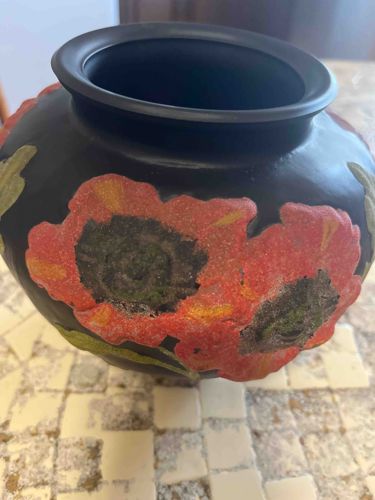
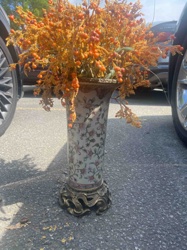
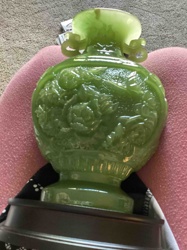
This is a ceramic vase, characterized by a squat, globular body and a slightly flared rim at the top. The overall color of the vase is a deep, matte black, providing a striking contrast to the vibrant decorations. The primary decoration consists of large, stylized floral motifs, most prominently in shades of red and orange, with hints of yellow, resembling poppies. These flowers feature a heavily textured surface, creating a tactile and three-dimensional effect that stands out against the smooth matte black background. The centers of these flowers appear to be a dark green or black, also with a textured, almost granular finish. Accompanying the red flowers are green leaf-like elements, which also display a raised, textured quality. The craftsmanship suggests hand-applied decorative elements, given the unevenness and organic nature of the textures. There are no visible maker's marks or signatures from the provided image. The condition appears good, with no obvious chips, cracks, or significant wear, though the textured areas show some slight variation in color saturation, which may be intentional or due to minor surface accumulation. The matte finish and robust form suggest an estimated age from mid-20th century to contemporary, possibly within an Arts and Crafts revival or more rustic aesthetic. The unique aspect is the pronounced textural application of the floral designs, which elevates the piece beyond a simple painted surface, indicating a level of artisanal effort.
AI Appraisal Report
Having visually examined the provided image of this Black Matte Ceramic Vase, I find its condition to be good, with no obvious chips, cracks, or significant wear. The vibrant, textured floral motifs, resembling poppies, are striking against the deep matte black background. The raised, tactile quality of the red, orange, and green elements suggests hand-applied decorative work, which I attribute to an artisanal approach rather than mass production. This unique textural application is a key factor in its aesthetic appeal and value.
Authenticity, based solely on this image, refers to the craftsmanship aligning with typical handmade ceramic items. Without physical inspection, I cannot confirm the exact ceramic composition or the precise method of decoration application (e.g., slip trailing, appliqué). The absence of maker's marks is common for studio pottery or smaller artisan pieces, but it limits definitive attribution to a specific artist or studio. The style points to a mid-20th century to contemporary origin, possibly influenced by Arts and Crafts aesthetics.
In terms of market conditions, unique handcrafted ceramic vases such as this generally appeal to collectors interested in decorative arts, studio pottery, or those seeking distinctive home decor. Comparables often include artisan-made ceramic pieces with unique textures or hand-painted details. While not rare in the sense of being a unique historical artifact, its individual artistry provides a degree of scarcity compared to factory-produced items. Demand exists within a niche market for well-executed artistic ceramics.
Factors significantly impacting value include the artisan quality, the good condition, and the strong visual impact of the textured decoration. However, the lack of provenance, artist attribution, or a signature limits its upper market potential significantly. To fully authenticate and assess value, an in-person examination would be critical to determine the exact type of ceramic, finer details of the texturing, and to search for any subtle, obscured marks. Scientific testing (e.g., thermoluminescence for age) would be overkill for a piece of this estimated value unless provenance suggested significant age, which is not the case here.