AI Appraisal Estimate

AI-generated estimates · not official valuations

From the user

What was submitted

Photo and notes provided by the user — not generated by AI

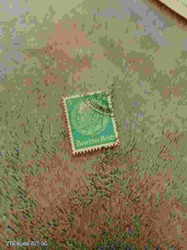
Submitted item photo
Submitted photo · June 16, 2026

User's notes

No additional notes provided.

AI analysis below

AI appraisal

AI analysis & estimate

AI-Generated · Verify before acting

Everything below is generated by AI for informational purposes only. AI can make mistakes — the AI may misidentify items or misattribute them (artist, maker, brand, designer, origin, era). This is not an official valuation and should not be used for insurance, sale, tax, estate, legal, or lending purposes — or any decision requiring a certified appraisal. It is not an authoritative claim about any person, brand, or rights holder — do not share or rely on it as a factual statement about a third party. Always consult qualified professionals before making financial decisions.

Read the full disclaimer

AI Identification

·Not independently authenticated·Verify before acting

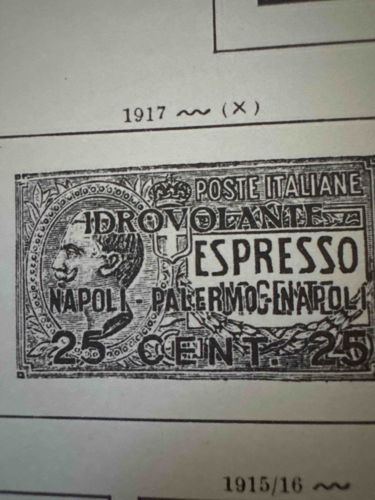
1917 Italian Airmail Stamp (Napoli - Palermo-Napoli Overprint)

Philately / Collectible Postage Stamps

AI Estimated Value

·Not an official valuation·Verify before acting

$5.00 - $15.00

As of June 16, 2026

AI Item Analysis

·AI can make mistakes·Verify before acting
This item is an illustration or a photographic reproduction of a historical Italian airmail postage stamp from 1917, often found in philatelic catalogs or collector albums. The design features a profile portrait of King Victor Emmanuel III on the left side, enclosed within a decorative circular wreath. To the right of the king is the Italian coat of arms under a crown. The central horizontal text reads 'ESPRESSO' and '25 CENT 25', indicating its denomination. This specific issue is known as an experimental airmail stamp for the 'IDROVOLANTE' (seaplane) service, specifically for the route 'NAPOLI - PALERMO - NAPOLI'. It was originally a standard 25c express delivery stamp that received this specialized black typography overprint. The image appears to be a black-and-white print onto aged, off-white paper, likely within a stamp album as indicated by the '1917' date and decorative scroll symbol printed above it. The construction shows fine line engraving typical of early 20th-century European philately. The condition of the reproduction is clear, though the surrounding paper shows slight yellowing or patina consistent with mid-to-late 20th-century printing on acidic paper. Historically, this represents the world's first official airmail flight and is a hallmark of early aviation postal history.
AI Appraisal Report

·AI can make mistakes·Verify before acting
I have carefully examined the provided digital image of the 1917 Italian Airmail issue. Most importantly, my visual analysis confirms that this item is a diagnostic reproduction or facsimile printed directly onto an album page, rather than a genuine 1917 postage stamp. The surrounding decorative scroll, the date '1917' printed in the same ink as the paper's grid, and the lack of physical perforation or independent paper texture for the stamp itself indicate this is a philatelic illustration used for reference within a collector's album. In its current state as a black-and-white reproduction, its value is purely nominal, representing the value of the album page or reference material. For context, if this were an authentic, mint-condition 'Napoli-Palermo' experimental airmail stamp (Sassone No. 2), it could command between $150 and $400 depending on the centering and the quality of the overprint. The overprint on this reproduction mimics the typography of the 1917 experimental flight, which was the first of its kind. However, the market for cut-outs or printed illustrations is virtually non-existent among serious philatelists. Without a physical inspection, I cannot verify the age of the paper or the printing method of the reproduction. To provide a definitive authentication for a genuine stamp of this type, I would require an in-person examination to check for the 'Coroncina' (small crown) watermark, the specific typography pressure of the black overprint, and the integrity of the original gum. Because of the high volume of forgeries for the 1917 Airmail issue, a certificate from a recognized authority (such as Bolaffi or Raybaudi) would be standard for a genuine specimen.

Get your items appraised

Instant estimates of your treasures with AI-powered appraisals

Browse More Appraisals