AI Appraisal Estimate

AI-generated estimates · not official valuations

From the user

What was submitted

Photo and notes provided by the user — not generated by AI

Submitted item photo
Submitted photo · June 4, 2026

User's notes

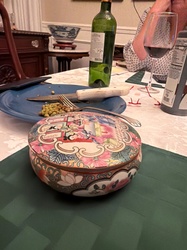
Porcelain bowl

AI analysis below

AI appraisal

AI analysis & estimate

AI-Generated · Verify before acting

Everything below is generated by AI for informational purposes only. AI can make mistakes — the AI may misidentify items or misattribute them (artist, maker, brand, designer, origin, era). This is not an official valuation and should not be used for insurance, sale, tax, estate, legal, or lending purposes — or any decision requiring a certified appraisal. It is not an authoritative claim about any person, brand, or rights holder — do not share or rely on it as a factual statement about a third party. Always consult qualified professionals before making financial decisions.

Note

This analysis also relies on unverified notes provided by the user, which may be incomplete or inaccurate and could affect the result.

Read the full disclaimer

AI Identification

·Not independently authenticated·Verify before acting

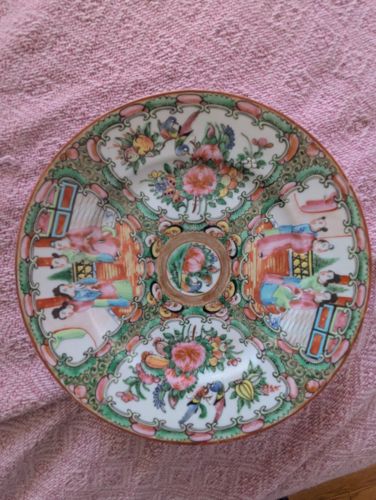
Chinese Rose Medallion Porcelain Plate

Asian Antiques - Chinese Export Porcelain

AI Estimated Value

·Not an official valuation·Verify before acting

$450.00 - $650.00

As of June 4, 2026

AI Item Analysis

·AI can make mistakes·Verify before acting
This is a classic example of Chinese Rose Medallion export porcelain, likely dating from the mid-to-late 19th century (Qing Dynasty) or a high-quality early 20th-century reproduction. The plate features the traditional four-panel layout radiating from a central gilded medallion containing a bird and peony. Two alternating panels depict domestic courtyard scenes with several figures (often called 'Mandarin' scenes), while the other two panels feature floral bouquets, peaches, and birds. The panels are separated by a 'famille rose' ground of green scrollwork, butterflies, and floral vines. The palette is rich with overglaze enamels in pinks, greens, blues, and oranges, accented with hand-painted gold highlights. The rim is decorated with a continuous border of pink flower heads and green foliage. This piece shows signs of hand-painting through slight variations in line weight and shading. The condition appears fair to good; there is visible wear to the gilded edges and the central medallion, consistent with age and use. No significant cracks or chips are immediately visible from this angle, though the surface shows typical kiln spitting and minor pitting standard for this era of production.
AI Appraisal Report

·AI can make mistakes·Verify before acting
Upon my virtual examination of this Chinese Rose Medallion export porcelain plate, I have identified it as a high-quality example likely dating to the mid-to-late 19th century. The piece exhibits the classic four-panel 'Mandarin' and floral configuration. The richness of the overglaze enamels and the presence of hand-applied gilding suggest an authentic Qing Dynasty export origin rather than a modern mass-produced imitation. The visible wear on the central medallion and rim gilding is consistent with 150 years of domestic use, which paradoxically supports its authenticity. The current market for Rose Medallion remains stable, though prices have softened from their peak in the early 2000s. Demand is highest for pieces with vibrant pinks and no restoration. While the kiln spitting and pitting noted are typical for the period, they do not detract significantly from the value; however, the gilding loss places it in the mid-range of recent auction comparables. Please note that this appraisal is based solely on digital images. A physical inspection is required to definitively rule out professional 'invisible' repairs or to check for resonance (the 'ring' of the porcelain), which confirms structural integrity. Full authentication would benefit from provenance documentation or ultraviolet light testing to ensure the enamel has not been over-painted. If a marked 'Made in China' stamp is found on the reverse (typically post-1891), the value would shift to the lower end of the provided estimate.

Get your items appraised

Instant estimates of your treasures with AI-powered appraisals

Browse More Appraisals