AI Appraisal Estimate

AI-generated estimates · not official valuations

From the user

What was submitted

Photo and notes provided by the user — not generated by AI

Submitted item photo
Submitted photo · June 19, 2026

User's notes

No additional notes provided.

AI analysis below

AI appraisal

AI analysis & estimate

AI-Generated · Verify before acting

Everything below is generated by AI for informational purposes only. AI can make mistakes — the AI may misidentify items or misattribute them (artist, maker, brand, designer, origin, era). This is not an official valuation and should not be used for insurance, sale, tax, estate, legal, or lending purposes — or any decision requiring a certified appraisal. It is not an authoritative claim about any person, brand, or rights holder — do not share or rely on it as a factual statement about a third party. Always consult qualified professionals before making financial decisions.

Read the full disclaimer

AI Identification

·Not independently authenticated·Verify before acting

Mid-20th Century Chinese Export Porcelain with 'Zhongguo Zhizao' Mark

Chinese Export Porcelain / Asian Antiques

AI Estimated Value

·Not an official valuation·Verify before acting

$40-80

As of June 19, 2026

AI Item Analysis

·AI can make mistakes·Verify before acting
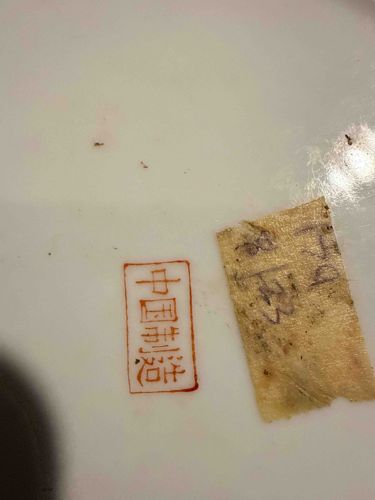
This item is a piece of Chinese export porcelain featuring a white glazed surface typical of 20th-century production. The most prominent feature is the iron-red stamped rectangular mark containing the four characters '中国制造' (Zhōngguó Zhìzào), which translates to 'Made in China.' This specific mark, written in simplified Chinese characters, indicates a production date likely from the late 1950s to the 1970s, as simplified characters became standardized in the People's Republic of China during this period. The porcelain body appears bright white with a smooth, reflective glaze, showing minor manufacturing artifacts such as small iron specks (pitting) common in high-fire ceramics. Attached next to the red stamp is a vintage adhesive paper label with handwritten inventory numbers or prices, which has yellowed and developed a brittle texture, suggesting it has been affixed for several decades. The application of the red stamp is slightly uneven, a common trait of mass-produced export wares from state-run factories of that era. There are no visible chips or cracks in the localized view, though the presence of some surface grime and minor staining near the markings suggests it has been handled throughout its history. The craftsmanship is consistent with functional export-grade porcelain of the mid-to-late 20th century.
AI Appraisal Report

·AI can make mistakes·Verify before acting
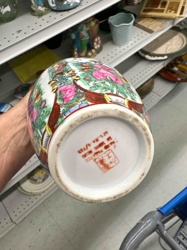
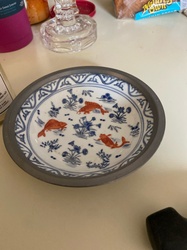
Based on my visual examination of this porcelain specimen, I identify it as a utilitarian Chinese export piece produced in the mid-to-late 20th century. The 'Zhongguo Zhizao' (Made in China) mark in simplified characters specifically points to the People's Republic of China era, likely post-1958. The porcelain reveals a characteristic bright white body with minor firing inclusions (pitting), consistent with mass-produced state-factory wares rather than fine imperial or early artistic ceramics. The condition appears fair to good; while no structural cracks are evident, the surface grime and oxidized adhesive on the vintage label indicate decades of storage. This type of porcelain was exported in vast quantities to Western markets, particularly during the 1960s and 70s. Consequently, it lacks the rarity required to command high antique premiums. Current market demand for 'People's Republic' era export-grade porcelain is modest, often utilized by collectors as decorative accents rather than high-stakes investments. Comparable pieces frequently sell in the double-digit range at general estate auctions. Factors limiting the value include the mass-produced nature of the iron-red stamp and the lack of hand-painted decorative complexity. It is important to note that this appraisal is based solely on digital images. A physical inspection is required to check for 'ring' resonance, translucency under UV light to detect hidden repairs, and tactile verification of the glaze thickness. No scientific testing (such as thermoluminescence) is warranted given the 20th-century origin, but provenance detailing the import history would further solidify the dating.

Get your items appraised

Instant estimates of your treasures with AI-powered appraisals

Browse More Appraisals