These notes were written by the person who submitted this item. Appraiser.AI has not verified them, and the AI's identification and estimate may rely on them.
AI Estimated Value
Not an official valuation
$50 - $100
AI estimate as of November 10, 2025 · verify with a professional before acting
AI-Generated · Verify before acting
Everything on this page is generated by AI for informational purposes only. AI can make mistakes — the AI may misidentify items or misattribute them (artist, maker, brand, designer, origin, era). This is not an official valuation and should not be used for insurance, sale, tax, estate, legal, or lending purposes — or any decision requiring a certified appraisal. It is not an authoritative claim about any person, brand, or rights holder — do not share or rely on it as a factual statement about a third party. Always consult qualified professionals before making financial decisions.
This analysis also relies on unverified notes provided by the user, which may be incomplete or inaccurate and could affect the result.
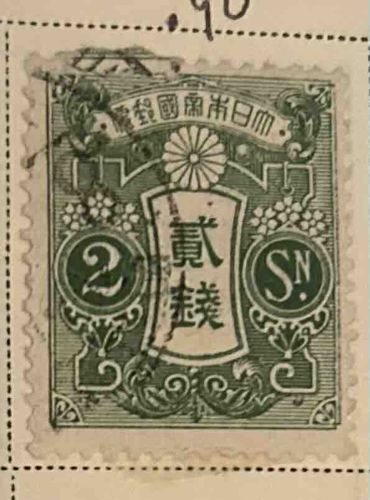
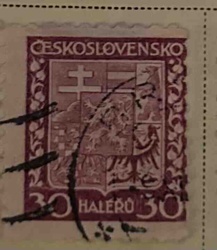
This item is a single, used Japanese postage stamp with a denomination of 2 Sen. The stamp is predominantly green, employing a dark shade for the intricate design elements against a lighter background. It features the Imperial Chrysanthemum Seal prominently at the top center, a symbol often associated with the Japanese monarchy and used on official government issues, including stamps, during the Meiji Era (1868-1912). Below the chrysanthemum, a banner displays Japanese characters, likely indicating the issuing authority or a phrase related to the nation. The design also incorporates ornate scrollwork and floral motifs, characteristic of the era's decorative arts. The numeral '2' is visible in a circular frame in the lower-left corner, signifying its 2 Sen value, and what appears to be 'SN' in a similar frame in the lower-right corner, potentially a security mark or an additional denomination indicator. The stamp is perforated along all four edges, indicating it was intended to be separated from a sheet. Visible condition issues include a prominent vertical cancellation mark in a dark ink, likely indicating postal usage, which runs vertically through the central Japanese characters. There are also signs of light wear and possible discoloration consistent with age and handling. The edges of the perforations appear largely intact but show minor fraying in some areas. The overall impression is one of a well-preserved but clearly used philatelic item, showcasing typical printing and design quality for Japanese stamps of its period, which often featured detailed engravings.
AI Appraisal Report
I have examined the provided image of the Used 2 Sen Japan Chrysanthemum Postage Stamp from the Meiji Era. Based on its appearance, I assess it to be an authentic stamp from that period, consistent with the design and printing methods of Japanese philately from the late 19th or early 20th century. The prominent Imperial Chrysanthemum Seal and the numeral '2' for its 'Sen' denomination align with known examples.
Condition-wise, the stamp shows clear signs of postal use, indicated by the dark, vertical cancellation mark. The perforations appear largely intact, though some minor fraying is visible. There's also light wear and discoloration consistent with its age. This condition, while not pristine, is typical for a used stamp of this era, and the cancellation itself adds to its historical narrative.
Market conditions for Meiji Era Japanese stamps are generally stable, with a consistent collector base. However, the 2 Sen denomination, while historic, is not exceptionally rare, especially in used condition. Common comparables for such well-preserved but used examples typically range in the double digits. The visible cancellation, while authentic, does not enhance its value beyond that of a standard used example, nor does it detract significantly unless it is overly heavy or obscures key design elements.
The demand for this specific stamp is moderate. While there's a steady interest in classic Japanese philately, this particular issue isn't considered a major rarity that would command a premium. Factors impacting its value include its used state and the commonness of this denomination. A crisp, unused example with original gum would fetch significantly more.
It is important to note that this appraisal is based solely on visual examination of the provided image. While the design and cancellation appear period-appropriate, I cannot definitively verify authenticity, paper type, watermarks, or subtle printing variations without a physical in-hand inspection. A professional philatelic expert would need to examine the stamp physically to confirm its authenticity, assess any repairs or hidden flaws, and accurately grade its condition, which could impact the final valuation.