AI estimate as of September 21, 2025 · verify with a professional before acting
AI-Generated · Verify before acting
Everything on this page is generated by AI for informational purposes only. AI can make mistakes — the AI may misidentify items or misattribute them (artist, maker, brand, designer, origin, era). This is not an official valuation and should not be used for insurance, sale, tax, estate, legal, or lending purposes — or any decision requiring a certified appraisal. It is not an authoritative claim about any person, brand, or rights holder — do not share or rely on it as a factual statement about a third party. Always consult qualified professionals before making financial decisions.
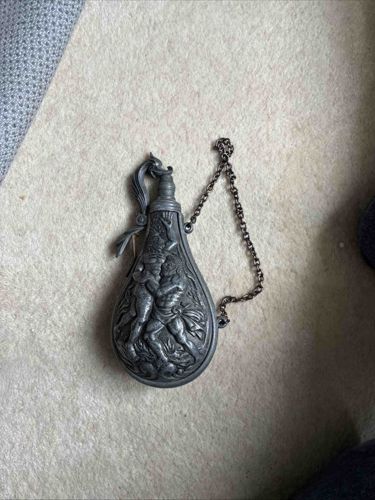
This item is an antique gunpowder flask, likely crafted from pewter or a similar lead-grey metal alloy, presenting a teardrop or pear-shaped body. Its surface is intricately embossed with what appears to be a mythological or allegorical scene featuring two dynamic, muscular figures, possibly a male and female, engaged in a struggle or dance amidst classical swirling drapery or clouds. The details of the figures, including their musculature and facial expressions, suggest a high level of craftsmanship in the embossing process. The flask features an integrated dispenser spout at the top, which appears to be designed for precise measurement of gunpowder. A decorative element resembling a plume or elaborate flourish extends from the top of the spout, adding to its ornate aesthetic. A small chain is attached to a loop on the side of the flask, presumably for securing the stopper (not visible) or for attaching the flask to a belt or other gear. The overall color is a uniform dark grey, indicative of aged pewter or a similar alloy, with a subtle patina suggesting considerable age. There are no immediately obvious significant condition issues such as dents or severe scratches, but the surface exhibits the typical wear and subtle darkening consistent with an antique item. The style suggests a 19th-century or earlier European origin, possibly influenced by classical or Renaissance artistic traditions. The quality of the embossing indicates a skilled artisan, and the overall design points to an item that was both functional and aesthetically pleasing.
AI Appraisal Report
Upon visual examination of this antique embossed pewter gunpowder flask, I observe an item in remarkably good condition for its age. The intricate embossing featuring mythological figures engaged in a dynamic scene is well-preserved, showing excellent detail in musculature and drapery. The dark grey patina is consistent with aged pewter or a similar alloy, suggesting authenticity rather than a modern reproduction. I discern no obvious significant dents, severe scratches, or repairs that would detract substantially from its value. The integrated dispenser spout and chain attachment appear original and intact.
Market conditions for antique firearms accessories, particularly those with artistic merit, remain steady. Comparable items of this quality, especially those with detailed figural embossing, regularly fetch prices in the mid to high hundreds. The demand for such pieces is driven by collectors of antique firearms, militaria, and decorative arts. The craftsmanship exhibited by this flask suggests it was made by a skilled artisan, contributing to its rarity and desirability. Factors positively impacting its value include the excellent state of preservation, the intricate and well-executed embossed artwork, and its apparent originality.
It is crucial to state that my assessment of authenticity is based solely on the provided image. While the visual indicators are positive, a definitive authentication would require an in-person examination. This would allow me to assess the metal composition more accurately, examine manufacturing techniques (e.g., seams, tool marks), and look for any subtle signs of restoration or alteration not visible in photographs. Furthermore, provenance documentation, such as historical sales records or family history, would significantly enhance its verifiable authenticity and, consequently, its market value. Scientific testing, such as XRF analysis, could confirm the metallic composition and age.