AI Appraisal Estimate

AI-generated estimates · not official valuations

From the user

What was submitted

Photo and notes provided by the user — not generated by AI

Submitted item photo
Submitted photo · June 1, 2026

User's notes

No additional notes provided.

AI analysis below

AI appraisal

AI analysis & estimate

AI-Generated · Verify before acting

Everything below is generated by AI for informational purposes only. AI can make mistakes — the AI may misidentify items or misattribute them (artist, maker, brand, designer, origin, era). This is not an official valuation and should not be used for insurance, sale, tax, estate, legal, or lending purposes — or any decision requiring a certified appraisal. It is not an authoritative claim about any person, brand, or rights holder — do not share or rely on it as a factual statement about a third party. Always consult qualified professionals before making financial decisions.

Read the full disclaimer

AI Identification

·Not independently authenticated·Verify before acting

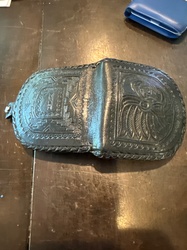
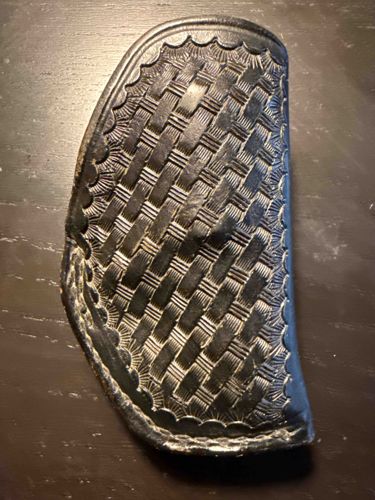
Vintage Basketweave Leather Pocket Holster

Firearms Accessories / Leather Goods

AI Estimated Value

·Not an official valuation·Verify before acting

$45.00-$65.00

As of June 1, 2026

AI Item Analysis

·AI can make mistakes·Verify before acting
This is a vintage pocket holster crafted from thick, high-quality tanned cowhide leather, dyed in a deep black finish. The exterior features a classic hand-tooled or machine-stamped basketweave pattern, which provides both a traditional aesthetic and functional texture for grip. The patterned area is framed by a decorative scalloped or 'sunburst' border stamp along the edges. It is constructed from a single piece of leather folded over and secured with heavy-duty light-colored stitching along the bottom and side, characteristic of semi-automatic or small revolver pocket holsters. The shape is asymmetrical, with a curved outer edge designed to conform to a pocket’s interior, helping to keep the firearm upright and breaking up the outline of the weapon. Visible condition includes moderate surface wear, particularly along the edges where the leather shows light graying or scuffing of the black dye, indicating frequent use and pocket friction. There is a slight patina of dust in the deep crevices of the stamping. The stitching appears intact and tight, suggesting mid-20th-century craftsmanship (circa 1970s-1990s). No visible maker's marks are on the face, though they may be on the reverse or interior. The leather demonstrates significant 'boning' or molding from a previous firearm, suggesting it was custom-fitted or well-worn for a specific compact handgun model.
AI Appraisal Report

·AI can make mistakes·Verify before acting
I have examined the digital representation of this vintage basketweave leather pocket holster. The item displays characteristics consistent with mid-to-late 20th-century American leathercraft, likely produced between 1970 and 1990. The deep black cowhide shows authentic surface wear and friction-induced scuffing along the edges, which is typical for a piece subjected to daily carry. The tight, heavy-duty contrast stitching remains intact, suggesting high structural integrity despite the age. The basketweave stamping is well-executed with professional-grade scalloped bordering, though the lack of a visible maker's mark on the front suggests it may be a high-quality boutique artisan piece or a standard catalog item from a prominent manufacturer like Hunter, Safariland, or Bianchi (whose marks are often localized on the reverse). The market for vintage leather gear remains steady, particularly for iconic holster styles that cater to 'Everyday Carry' (EDC) enthusiasts and collectors of vintage firearms. While common in design, the condition and the aesthetic appeal of the hand-tooled look drive its value. Factors limiting the value include the heavy molding, which restricts its use to the specific handgun model for which it was originally 'boned.' Without a physical inspection, I cannot confirm the leather's suppleness or the presence of hidden dry rot. Full authentication would require a tactile check of the leather's moisture content, a view of the reverse side to identify the manufacturer or model stamp, and provenance regarding the specific firearm it was molded for to accurately target the right buyer.

Get your items appraised

Instant estimates of your treasures with AI-powered appraisals

Browse More Appraisals