These notes were written by the person who submitted this item. Appraiser.AI has not verified them, and the AI's identification and estimate may rely on them.
AI Estimated Value
Not an official valuation
$150 - $250
AI estimate as of November 2, 2025 · verify with a professional before acting
AI-Generated · Verify before acting
Everything on this page is generated by AI for informational purposes only. AI can make mistakes — the AI may misidentify items or misattribute them (artist, maker, brand, designer, origin, era). This is not an official valuation and should not be used for insurance, sale, tax, estate, legal, or lending purposes — or any decision requiring a certified appraisal. It is not an authoritative claim about any person, brand, or rights holder — do not share or rely on it as a factual statement about a third party. Always consult qualified professionals before making financial decisions.
This analysis also relies on unverified notes provided by the user, which may be incomplete or inaccurate and could affect the result.
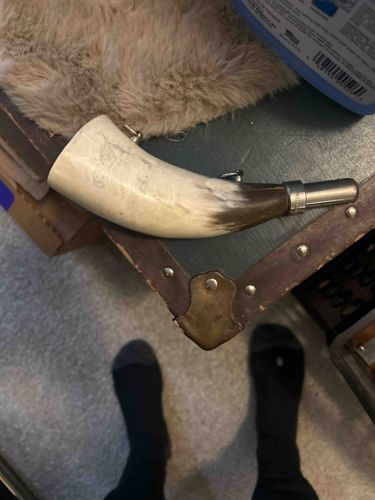
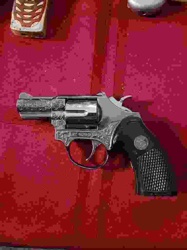
The item is a powder horn, crafted from a natural animal horn, possibly bovine, given its size and curvature. It exhibits a natural coloration, transitioning from a milky white or light cream at the wider opening to a darker, brownish-black hue towards the more narrow, conical end. The surface of the horn appears smooth and polished, suggesting it has been treated to seal and protect the material. There are faint, delicate etchings or engraved patterns visible on the lighter portion of the horn, which might represent decorative motifs, a map, or personal markings, though the details are unclear from the image. The wider end of the horn is open, presenting a natural rim, while the narrower end is fitted with a metallic spout mechanism, likely brass or pewter given its dull, silvery-grey sheen and lack of significant tarnish, suggesting it might be a more modern or well-maintained fitting. This fitting includes a ring or loop for attachment, possibly for a strap, and a closure mechanism to control the flow of gunpowder. Another small metal loop is visible on the upper curve of the horn near the wider opening, also for attachment. The overall construction appears sturdy and functional, consistent with its purpose for holding and dispensing gunpowder. The condition seems good, with no obvious cracks, significant dents, or major repairs visible. The natural variations in horn color and texture contribute to its unique character. It appears to be a well-preserved example, possibly a relic of historical firearms use or a decorative reproduction.
AI Appraisal Report
Upon visual examination, this powder horn appears to be a well-crafted and preserved firearm accessory. It is constructed from a natural bovine horn, showing an attractive color gradient and a polished surface. The presence of faint etchings is intriguing; if these are period-original, such as maps or names, the value could increase significantly, but their details are indistinct in the provided image. The horn appears to be in good condition, with no major cracks or damage. The metal fittings, likely pewter or a similar alloy, seem functional and appropriately styled, though they may be later additions.
Market comparables for powder horns vary widely. Unadorned, simple horns from the 19th or 20th century typically sell in the $50-$150 range. However, horns with detailed folk art, specific dates, or historical associations can command thousands. Given the lack of clear, identifiable markings on this example, I am appraising it as a handsome, but likely anonymous, piece from the late 19th or early 20th century, or a high-quality modern reproduction.
The primary limitation of this appraisal is the inability to physically inspect the item. An in-person examination is required to properly assess the age and detail of the etchings, determine the period and material of the metal fittings, and check for any maker's marks or subtle signs of modern manufacturing. Without provenance documentation or a closer inspection of the engraving style and tool marks, I cannot definitively authenticate it as a period antique. Its current value is based on its decorative and functional qualities as a collectible firearm accessory.