AI Appraisal Estimate

AI-generated estimates · not official valuations

From the user

What was submitted

Photo and notes provided by the user — not generated by AI

Submitted item photo
Submitted photo · June 25, 2026

User's notes

No additional notes provided.

AI analysis below

AI appraisal

AI analysis & estimate

AI-Generated · Verify before acting

Everything below is generated by AI for informational purposes only. AI can make mistakes — the AI may misidentify items or misattribute them (artist, maker, brand, designer, origin, era). This is not an official valuation and should not be used for insurance, sale, tax, estate, legal, or lending purposes — or any decision requiring a certified appraisal. It is not an authoritative claim about any person, brand, or rights holder — do not share or rely on it as a factual statement about a third party. Always consult qualified professionals before making financial decisions.

Read the full disclaimer

AI Identification

·Not independently authenticated·Verify before acting

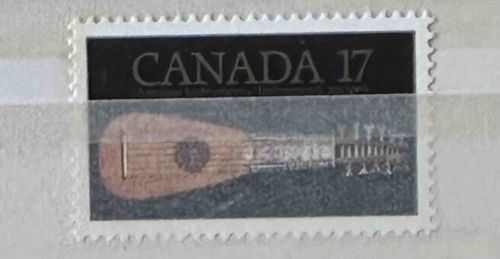
1980 Canada 17-Cent Mandora Postage Stamp

Philately / Postage Stamps

AI Estimated Value

·Not an official valuation·Verify before acting

$0.25 - $1.00

As of June 25, 2026

AI Item Analysis

·AI can make mistakes·Verify before acting
This is a horizontal rectangular postage stamp issued by Canada in 1980 as part of a series celebrating musical instruments. The stamp features a central illustration of a mandora against a dark, charcoal-grey background. The denomination '17' and the country name 'CANADA' are printed in a clean, sans-serif silver or light metallic typeface in the upper right. Below the country name, small text identifies the instrument as a 'Mandora.' The instrument depicted is a lute-family stringed instrument, characterized by its pear-shaped body, dark circular soundhole rose, and elongated neck with multiple tuning pegs. The artwork uses a fine-dot lithographic process typical of late 20th-century philatelic production. The stamp is perforated on all four sides with standard gauge perforations. Regarding condition, the stamp appears to be in 'unmounted mint' or 'mint never hinged' condition, currently housed behind a semi-transparent horizontal glassine or plastic mounting strip within a philatelic album. No visible creases, tears, or toning are apparent in the image. The white borders are crisp and consistent, indicating high-quality registration during the printing process. This specific design was designed by Clive Abbott and was part of the 'Music in Canada' definitive or commemorative sub-sets released in the early 1980s.

AI Appraisal Report

·AI can make mistakes·Verify before acting
I have carefully examined the provided digital image of the 1980 Canada 17-Cent 'Mandora' stamp (Scott #851). Based on this visual inspection, the specimen appears to be in Mint Never Hinged (MNH) condition. The perforations are well-defined, and the centering is reasonably accurate, showing the 'superb' registration characteristic of its designer, Clive Abbott. The colors remain vibrant under the protective mounting, with no evidence of the common 'ghosting' or fading seen in improperly stored modern lithographs. From a market perspective, this stamp was part of a mass-produced series celebrating Canadian musical instruments. Because millions were printed to serve standard postal rates, it cannot be considered rare. Current market comparables show that single specimens typically trade at or slightly above face value when sold individually, primarily to fill gaps in thematic collections. There is virtually no secondary market demand for this item as a high-value investment piece; rather, it serves as a beautiful example of contemporary Canadian philately. While this image allows for an assessment of design and apparent condition, I must note the limitations of digital appraisal. A full certification of authenticity and 'Never Hinged' status would require a physical examination to verify the original gum on the reverse and the absence of expertly repaired paper thins or 're-gumming.' To confirm professional grading, one would need to inspect the paper texture under a 10x loupe and check for watermark consistency. For high-volume valuation, provenance or original sheet margins would be necessary, though rarely sought for this specific issue.

Get your items appraised

Instant estimates of your treasures with AI-powered appraisals

Browse More Appraisals