AI estimate as of July 18, 2025 · verify with a professional before acting
AI-Generated · Verify before acting
Everything on this page is generated by AI for informational purposes only. AI can make mistakes — the AI may misidentify items or misattribute them (artist, maker, brand, designer, origin, era). This is not an official valuation and should not be used for insurance, sale, tax, estate, legal, or lending purposes — or any decision requiring a certified appraisal. It is not an authoritative claim about any person, brand, or rights holder — do not share or rely on it as a factual statement about a third party. Always consult qualified professionals before making financial decisions.
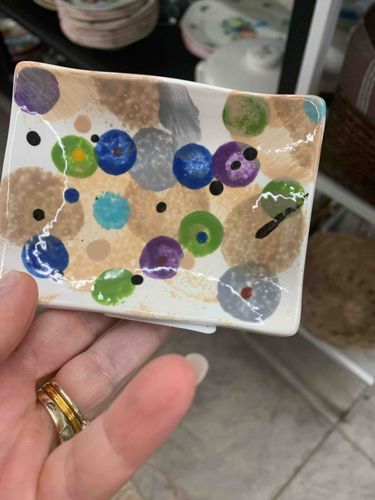
This is a small, rectangular ceramic dish, likely intended for decorative purposes or as a small catch-all, perhaps for trinkets or a soap rest. Its approximate dimensions can be inferred by its placement in a person's hand, suggesting it is no more than 4-6 inches in length. The material appears to be glazed earthenware or porcelain, with a smooth, glossy finish on the top surface. The primary color of the dish's background is an off-white or cream, acting as a canvas for the abstract, polka-dot-like design. The design features an array of circular and irregularly shaped 'dots' in various sizes and colors, including shades of blue, green, purple, gray, and brown, some with smaller black or red centers. There are also smaller, solid black dots scattered throughout. A notable characteristic is the speckled or spattered appearance of the beige/brown areas, possibly created by a sponge or brush technique, adding texture to the visual design. Some areas exhibit thin, wavy white lines that appear to be intentionally applied as part of the decorative motif, rather than damage, though some light surface scratches are faintly visible, particularly within these white lines and on the glossy surface, indicating some wear from handling or light use. The edges of the dish are slightly raised, forming a shallow lip. There are no visible maker's marks or signatures from the provided image, so manufacturing details are not discernible. The style suggests a modern, perhaps mid-20th century to contemporary, artistic aesthetic, possibly hand-painted. The craftsmanship appears to be reasonably good for a decorative item, with vibrant colors and a consistent glaze, though the "painted" nature of the design suggests it may not be a mass-produced, high-end item but rather something more artisanal or craft-oriented.
AI Appraisal Report
Upon visual examination of the images provided, I have assessed this small, rectangular ceramic trinket dish. The piece presents a modern, abstract polka dot motif on a cream-colored, glazed earthenware or porcelain base. The design, featuring a vibrant palette of blues, greens, purples, and browns, appears to be hand-painted, suggesting it is likely a studio pottery piece or a small-batch artisanal item rather than a mass-produced object. The overall condition appears good, with a consistent glaze and vivid colors. I did note some faint surface scratches and light wear, consistent with gentle use. The most significant factor limiting this appraisal is the absence of any visible maker's marks or signatures. Without a known artist, workshop, or manufacturer, the value is determined primarily by its decorative and utilitarian appeal rather than by collector demand for a specific name.
Market comparables for unsigned, contemporary studio pottery of this size and quality are modest. Demand is generally driven by aesthetic appeal for interior decor. While the design is charming, its lack of identifiable origin or discernible rarity places it in the general category of decorative crafts. A definitive valuation would require an in-person examination to confirm the material (e.g., earthenware vs. porcelain), search for any hidden marks under magnification, and assess the quality of the craftsmanship more closely. Verifying the artist, if possible through provenance, would be the single most important factor that could substantially increase its value.