AI estimate as of August 20, 2025 · verify with a professional before acting
AI-Generated · Verify before acting
Everything on this page is generated by AI for informational purposes only. AI can make mistakes — the AI may misidentify items or misattribute them (artist, maker, brand, designer, origin, era). This is not an official valuation and should not be used for insurance, sale, tax, estate, legal, or lending purposes — or any decision requiring a certified appraisal. It is not an authoritative claim about any person, brand, or rights holder — do not share or rely on it as a factual statement about a third party. Always consult qualified professionals before making financial decisions.
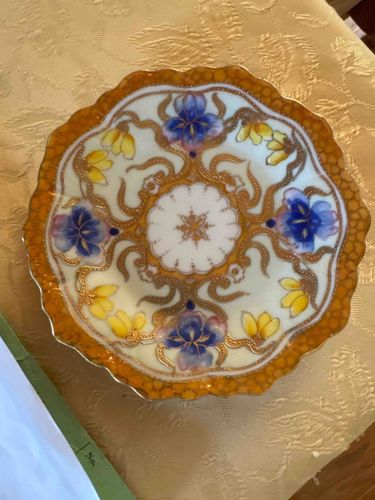
This is a small, ornate decorative plate or shallow dish, likely crafted from porcelain or fine ceramic. Its form is circular with a distinctive scalloped or undulating rim, adding to its decorative appeal. The primary color palette features a light, possibly cream or off-white base, providing a gentle contrast to the rich, applied decorations. The most striking visual element is the extensive use of raised, gilded enamel work, forming intricate swirling patterns that evoke a Secessionist or Art Nouveau aesthetic. These gold-toned scrolls extend around a central medallion, which features a detailed, possibly star-like or floral motif. Interspersed within these gilded flourishes are hand-painted floral designs, specifically featuring vibrant blue-purple irises and cheerful yellow bell-shaped flowers or buttercups. The rim of the plate is heavily embellished with a solid band of iridescent or raised orange/amber enamel, creating a honeycomb or stippled texture, further outlined with a thin gold line. The craftsmanship appears to be of high quality, indicative of detailed handwork, particularly in the fine brushstrokes of the flowers and the precise application of the raised gold. There are no immediate visible signs of major damage like chips, cracks, or significant repair, suggesting good preservation. The surface exhibits a slight sheen, typical of glazed ceramics. The overall design and decorative style suggest an estimated age from the late 19th to early 20th century, possibly Japanese or European in origin, given the aesthetic blend of naturalistic motifs with bold, geometric patterning. The size appears to be relatively small, consistent with a trinket dish, pin dish, or single-serving dessert plate.
AI Appraisal Report
I have carefully examined the provided image of this scalloped porcelain plate with gilded enamel and hand-painted flowers. Visually, the condition appears excellent, with no apparent chips, cracks, or significant wear to the gilding or enamel. The colors remain vibrant. Authenticity is difficult to ascertain solely from an image, but the quality of the hand-painting, particularly the irises and bell flowers, combined with the detailed raised gilding and textured orange enamel, suggests genuine craftsmanship typical of late 19th to early 20th century decorative arts. The stylistic blend of naturalistic florals with more geometric, almost Secessionist-like goldwork, points to either European (possibly Austrian or German) or Japanese export porcelain of that period.
Market conditions for detailed, well-preserved decorative ceramics of this era are steady. Comparables would include pieces by makers such as Morimura Bros. (Noritake) from Japan, or European art pottery. Items with extensive hand-decoration, particularly raised enamel and gilding, tend to command higher prices. The perceived rarity is moderate; while not unique, plates of this specific decorative quality and condition are not exceedingly common. Factors positively impacting value include the intricate handwork, excellent visual condition, and appealing aesthetic. However, the exact maker and country of origin cannot be confirmed without a physical examination of the reverse side for marks. A physical inspection would also allow for tactile assessment of the porcelain quality and enamel application. Full authentication and a more precise valuation would benefit from examining any backstamps or artist signatures, and potentially UV light testing for repairs. Without these, identifying the exact manufacturer significantly limits the top-end valuation.