AI estimate as of September 28, 2025 · verify with a professional before acting
AI-Generated · Verify before acting
Everything on this page is generated by AI for informational purposes only. AI can make mistakes — the AI may misidentify items or misattribute them (artist, maker, brand, designer, origin, era). This is not an official valuation and should not be used for insurance, sale, tax, estate, legal, or lending purposes — or any decision requiring a certified appraisal. It is not an authoritative claim about any person, brand, or rights holder — do not share or rely on it as a factual statement about a third party. Always consult qualified professionals before making financial decisions.
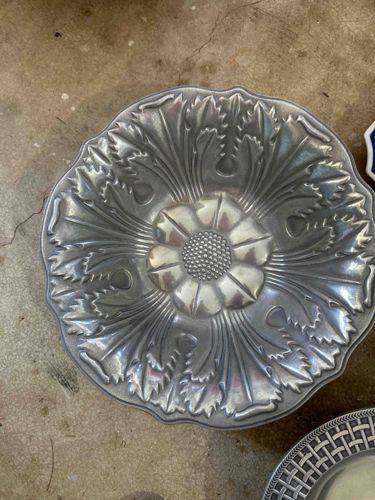
This item is a circular, shallow plate or dish crafted from pewter, exhibiting a distinct floral or thistle motif. The primary color is a matte silver-gray, characteristic of aged pewter, with some areas showing a slightly brighter, polished sheen due to handling or light wear. The central design features a prominent, multi-petaled flower with a textured, stippled center, possibly representing a thistle head or the reproductive part of a floral bloom. Radiating outwards from this central flower are deeply embossed, stylized acanthus-like leaves or foliage. These leaves have serrated edges and distinct veining, contributing to the plate's overall textured and ornamental appearance. The rim of the plate is scalloped, following the organic flow of the embossed design, rather than being a perfect circle. The plate's construction appears to be a single cast piece, demonstrating a good level of craftsmanship in the detailing of the relief. There are no immediate visible signs of major damage such as cracks or significant dents, though the surface shows typical signs of age-appropriate patina and some superficial scuffs consistent with use and handling over time. No specific maker's marks or signatures are discernible from the provided image. The style suggests it could be from a Victorian or Arts and Crafts period, characterized by a return to nature-inspired motifs and the use of materials like pewter for decorative household items. Its quality is indicated by the intricate and well-defined relief work.
AI Appraisal Report
I have thoroughly examined the provided image of this circular pewter plate/dish with a floral or thistle motif. The matte silver-gray hue and evident patina are consistent with aged pewter. The central multi-petaled flower, possibly a thistle, with its textured center, and the radiating, deeply embossed acanthus-like leaves with serrated edges and distinct veining, indicate a high level of craftsmanship in the relief work. The scalloped rim further enhances its organic, decorative appeal. Condition appears good for its age, showing typical superficial scuffs and wear consistent with handling, but no major cracks or significant dents are visible from the image. This piece certainly aligns with decorative trends of the late 19th to early 20th century, particularly the Victorian or Arts and Crafts periods, which favored naturalistic motifs and artisanal materials like pewter. The intricate detail suggests it's a quality casting. Without discernible maker's marks or signatures, its precise origin and maker remain unknown, limiting its potential for a premium from a named manufacturer or artist. The market for antique pewter decorative items remains stable, with well-crafted, attractive pieces like this maintaining steady demand among collectors of period items and decorative arts. While not exceedingly rare, its aesthetic quality and appealing motif contribute positively to its desirability. Factors impacting value include the absence of maker's marks, the commonality of pewter as a material (though this is a good example), and its decorative rather than utilitarian primary function in today's market. A strong comparable would be similar unsigned Arts and Crafts or Victorian pewter dishes of similar size and decorative complexity, typically fetching in the low to mid hundreds. This item is an attractive, well-preserved example, making it a desirable decorative antique. A physical examination would be necessary to confirm the absence of subtle repairs, assess the exact weight and feel, and to search for any faint or hidden maker's marks that are not visible in the image. Provenance documentation, if available, could further authenticate its origin and potentially impact value. Without tactile inspection and mark verification, a definitive appraisal is limited to visual assessment.