These notes were written by the person who submitted this item. Appraiser.AI has not verified them, and the AI's identification and estimate may rely on them.
AI Estimated Value
Not an official valuation
$40-$70
AI estimate as of November 25, 2025 · verify with a professional before acting
AI-Generated · Verify before acting
Everything on this page is generated by AI for informational purposes only. AI can make mistakes — the AI may misidentify items or misattribute them (artist, maker, brand, designer, origin, era). This is not an official valuation and should not be used for insurance, sale, tax, estate, legal, or lending purposes — or any decision requiring a certified appraisal. It is not an authoritative claim about any person, brand, or rights holder — do not share or rely on it as a factual statement about a third party. Always consult qualified professionals before making financial decisions.
This analysis also relies on unverified notes provided by the user, which may be incomplete or inaccurate and could affect the result.
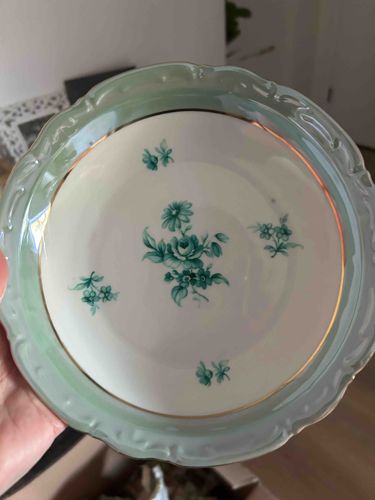
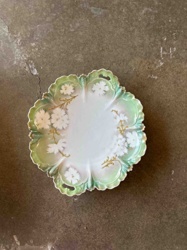
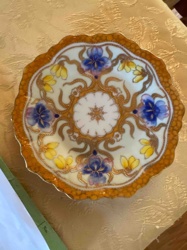
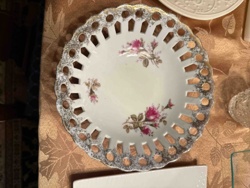
This item is a vintage decorative porcelain dish, possibly a serving plate, salad plate, or shallow bowl, characterized by its elegant design and soft color palette. It features a predominantly white or off-white central well adorned with a hand-painted or transfer-printed floral motif in a muted teal or emerald green hue. The main floral cluster, centered on the dish, appears to be a depiction of roses or similar multi-petaled flowers, accompanied by smaller sprigs of blossoms scattered around the rim. A distinct gold trim, likely gilded, encircles the inner edge of the well, providing a luxurious accent. The outer rim of the dish is a striking pastel green or celadon color, possibly a pearlescent or iridescent glaze, transitioning smoothly from the central white area. This outer rim is further embellished with a scalloped or fluted edge, showcasing a relief pattern that adds texture and visual interest. The craftsmanship suggests it is made of fine porcelain or bone china, indicated by its apparent thinness and lustrous finish. There are no clear manufacturer's marks visible in the provided image, but the style points towards an early to mid-20th-century aesthetic, potentially from Europe or Asia, given the context 'China' provided. The condition appears good overall, with some minor visible wear on the gold trim consistent with age and use, and possibly a few faint surface scratches or imperfections in the glaze, but no obvious chips, cracks, or significant damage are apparent from the limited view.
AI Appraisal Report
This vintage decorative porcelain dish presents as a charming piece, likely dating from the early to mid-20th century. Based on the visual examination of the provided image, the condition appears good, with minor wear on the gold trim consistent with age and use, and no apparent chips, cracks, or significant damage. The overall aesthetic, featuring a white central well with a green floral motif, gold trim, and a pastel green or celadon outer rim with a fluted edge, is quite appealing. The mention of 'China' likely refers to the country of origin, which is common for such decorative wares from that period.
Market conditions for vintage decorative plates and dishes are generally stable but not exceptionally strong unless the item is from a renowned manufacturer or features intricate, hand-painted artistry. Comparables in the market, often found on platforms like Etsy, eBay, or at antique malls, suggest that similar unmarked decorative porcelain pieces with floral motifs and gold accents typically retail in the $30-$80 range, depending on condition, specific design, and seller. While the design is attractive, the absence of clear manufacturer's marks significantly limits its value; branded pieces from notable porcelain makers would command considerably higher prices.
Demand for such items is moderate, primarily from collectors of vintage home decor or those seeking specific color palettes. Rarity is difficult to assess without maker's marks, but similar items were produced in large quantities. The main factors impacting value are the lack of identifiable provenance and the item's function as a decorative piece rather than a collectible from an esteemed brand.
Limitations apply to authenticity verification from images alone. A physical examination would be crucial to confirm the material (porcelain vs. bone china), assess the quality and application of the floral motif (hand-painted vs. transfer-printed), and thoroughly check for any faint marks or hidden damage. Authenticity hinges on a physical inspection and ideally, provenance documentation, which is currently unavailable. Without these, the appraisal remains an estimate based on visual characteristics and market trends for similar unmarked vintage decorative porcelain."