AI estimate as of October 27, 2025 · verify with a professional before acting
AI-Generated · Verify before acting
Everything on this page is generated by AI for informational purposes only. AI can make mistakes — the AI may misidentify items or misattribute them (artist, maker, brand, designer, origin, era). This is not an official valuation and should not be used for insurance, sale, tax, estate, legal, or lending purposes — or any decision requiring a certified appraisal. It is not an authoritative claim about any person, brand, or rights holder — do not share or rely on it as a factual statement about a third party. Always consult qualified professionals before making financial decisions.
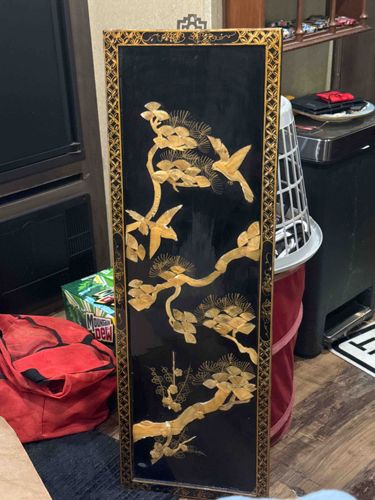
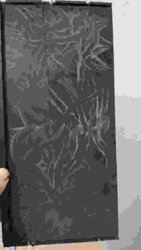
This item is a rectangular East Asian style decorative wall panel, characterized by a striking black lacquer background adorned with raised, gilt, or possibly shell inlay motifs. The central design depicts a naturalistic scene featuring two birds amidst flowering and budding branches that appear to be identifiable as pine. The birds are rendered in a slightly stylized manner, one in flight facing right, and the other perched on a branch, also facing right. The branches are intricately detailed with leaves, clusters of needles, and blossoms, all executed in a lustrous coppery-gold color against the deep black ground, creating a high contrast and visually appealing effect. The panel is framed by a border of similar gilded or inlaid design, featuring a repeating geometric pattern that encircles the central artwork. The construction appears to be of wood or a composite material, coated multiple times with lacquer to achieve the glossy, smooth finish. The raised elements suggest a technique like guri-bori or a similar relief lacquer work, or potentially intricate shell inlay (mother-of-pearl) that has been treated to achieve its golden hue. The finish appears to be in good to fair condition, with some visible dust accumulation and potential minor surface wear consistent with age and display, but no overt damage like cracks or chips is discernible from the provided image. The craftsmanship suggests a handcrafted piece, typical of traditional East Asian decorative arts, possibly from the mid-20th century or earlier, though precise dating without further inspection is difficult. The overall aesthetic points to an item valued for its decorative qualities and traditional artistry.
AI Appraisal Report
I have examined the provided image of this East Asian lacquer wall panel with birds and pine. Visually, the condition appears good to fair; while some dust accumulation and minor surface wear consistent with age are detectable, I observe no overt damage such as cracks or chips. The high contrast of the coppery-gold motifs against the deep black lacquer is striking. Authenticity, based solely on this image, suggests a handcrafted piece consistent with traditional East Asian decorative arts, potentially from the mid-20th century or earlier.
Market conditions for decorative lacquer panels of this type are generally stable, with a moderate demand for well-preserved examples. Comparable items, typically found in online antique marketplaces or specialized decorative art auctions, range widely in price depending on age, artistic merit, and condition. This panel exhibits good design and craftsmanship, which adds to its decorative appeal. While not exceptionally rare, panels with intricate gilded or inlaid elements like this one are more desirable than simpler designs.
Factors significantly impacting value include the quality of the lacquer finish, the intricacy and material veracity of the raised work (whether it's gilt lacquer, guri-bori, or genuine mother-of-pearl inlay), and overall condition. The age and origin (e.g., Japanese, Chinese, Vietnamese, Korean) could substantially affect value, but these cannot be determined from the image alone.
It is important to note that authenticity verification is limited without physical inspection. For a full authentication, I would require an in-person examination to assess the lacquer layers, the precise materials used for the raised elements (e.g., verifying if it's shell inlay or gilt lacquer), and the construction techniques. Provenance documentation or scientific testing of materials (e.g., carbon dating for age) would be crucial for precise dating and origin, which could significantly refine this appraisal.