AI identification & appraisal estimate

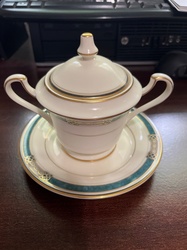
Haviland Limoges Hand-Painted Floral Teacup

This name is the AI's identification of the item — it may be incorrect.

Submitted photo of Haviland Limoges Hand-Painted Floral Teacup
Photo submitted by the user — not generated by AI

User's notes

China

These notes were written by the person who submitted this item. Appraiser.AI has not verified them, and the AI's identification and estimate may rely on them.

AI Estimated Value

Not an official valuation

$75 - $125

AI estimate as of October 15, 2025 · verify with a professional before acting

AI-Generated · Verify before acting

Everything on this page is generated by AI for informational purposes only. AI can make mistakes — the AI may misidentify items or misattribute them (artist, maker, brand, designer, origin, era). This is not an official valuation and should not be used for insurance, sale, tax, estate, legal, or lending purposes — or any decision requiring a certified appraisal. It is not an authoritative claim about any person, brand, or rights holder — do not share or rely on it as a factual statement about a third party. Always consult qualified professionals before making financial decisions.

This analysis also relies on unverified notes provided by the user, which may be incomplete or inaccurate and could affect the result.

Read the full disclaimer

AI Item Analysis

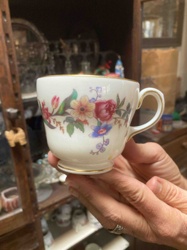
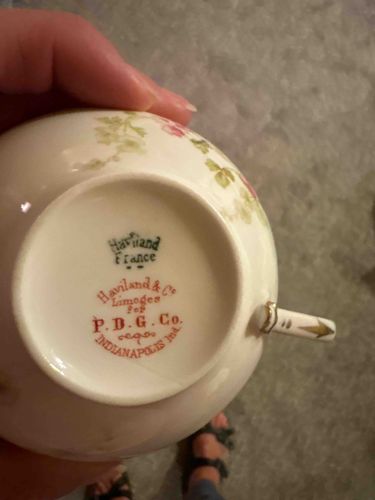
This item is a Haviland Limoges teacup, evidenced by the clear manufacturer's marks on the base. The visible marks include 'Haviland France' in green, and 'Haviland & Co. Limoges' with 'P.D.G. Co. Indianapolis Ind.' in red. This dual marking with the retailer's name (P.D.G. Co. Indianapolis Ind.) indicates it was produced for a specific distributor. The teacup is made of fine porcelain, characteristic of Limoges ware, and features a creamy white base color. It is adorned with a delicate, hand-painted floral pattern, visible on the exterior and potentially the interior or rim, with colors including soft pinks, light greens, and possibly other pastel hues in a botanical motif. The handle is slender and curved, decorated with what appears to be gilded accents or a small arrow-like design at its tip, suggesting a touch of luxury and refinement. The overall condition appears good from the visible portion, with no obvious chips or cracks, although the full extent of wear can't be assessed from a single image. The presence of the retailer's mark suggests a late 19th to early 20th-century production, a common period for Haviland's export to the United States. The craftsmanship, particularly the hand-painted details and fine porcelain, indicates a high-quality item designed for formal tea service. The glaze appears intact and glossy, reflecting light.
AI Appraisal Report

I have examined the provided image and description of this Haviland Limoges Hand-Painted Floral Teacup. Based on the clear 'Haviland France' and 'Haviland & Co. Limoges' marks, along with the 'P.D.G. Co. Indianapolis Ind.' retailer's mark, I can confidently authenticate this as a genuine Haviland Limoges piece. The presence of the retailer's mark strongly suggests a late 19th to early 20th-century production, a period when Haviland frequently collaborated with US distributors. The teacup appears to be in good condition, with no visible chips or cracks from the image. The hand-painted floral decoration and gilded accents on the handle are typical of Haviland's quality and craftsmanship. The glossy glaze also indicates good preservation. In terms of market conditions, single Haviland teacups, even hand-painted ones, generally command modest prices compared to full sets or more elaborate serving pieces. While Haviland Limoges maintains a collector base, the market for individual teacups is steady rather than exceptionally high-demand. Rarity is not a major factor for a standard Haviland teacup of this type; they were produced in significant quantities. The main factors impacting value are the delicate hand-painted motifs, the clear manufacturer and retailer marks, and the apparent excellent condition. However, without a physical inspection, I cannot fully assess for hairline cracks, crazing, interior wear, or professional repairs that would significantly diminish value. A hands-on examination, potentially with UV light, would be necessary to confirm the absence of restoration and the true extent of any wear not visible in the image. Although the authenticity of the marks is clear, a full provenance history beyond the retailer's mark would add further security for higher-end valuation.

Keep exploring

More dinnerware/teaware appraisals

Get your items appraised

Instant AI-powered appraisal estimates from a photo

Browse More Appraisals