These notes were written by the person who submitted this item. Appraiser.AI has not verified them, and the AI's identification and estimate may rely on them.
AI Estimated Value
Not an official valuation
$35-65
AI estimate as of November 28, 2025 · verify with a professional before acting
AI-Generated · Verify before acting
Everything on this page is generated by AI for informational purposes only. AI can make mistakes — the AI may misidentify items or misattribute them (artist, maker, brand, designer, origin, era). This is not an official valuation and should not be used for insurance, sale, tax, estate, legal, or lending purposes — or any decision requiring a certified appraisal. It is not an authoritative claim about any person, brand, or rights holder — do not share or rely on it as a factual statement about a third party. Always consult qualified professionals before making financial decisions.
This analysis also relies on unverified notes provided by the user, which may be incomplete or inaccurate and could affect the result.
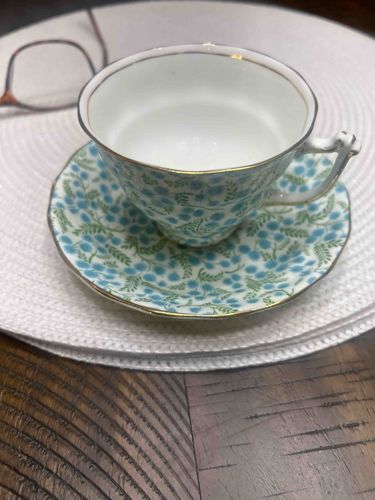
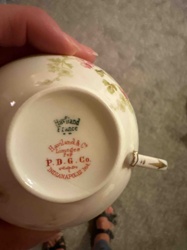
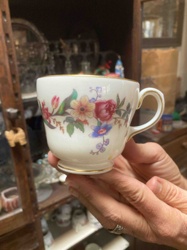
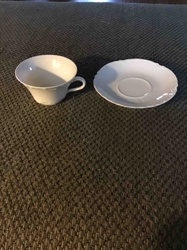
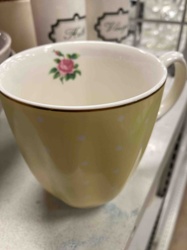
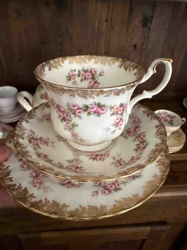
This is a vintage demitasse cup and saucer set, likely made of fine bone china or porcelain, given its delicate appearance and typical construction for such items. The set features a charming and intricate floral pattern primarily in shades of blue and green, set against a light, possibly white or cream-colored background. The blue elements appear as small, clustered berries or flowers, while the green forms delicate leaves and vines, creating a dense, all-over botanical motif. Both the cup and saucer are rimmed with a thin, elegant band of gold gilding, which shows some minor wear consistent with age and use, particularly along the lip of the cup and the edge of the saucer. The cup has a classic demitasse shape, small and delicate, with a C-shaped handle that also appears to have gold accents. The saucer is shallow with a slightly raised center to accommodate the cup. The interior of the cup is a plain white, providing a contrast to the busy exterior pattern. The overall condition appears good for an item of its likely age, with no apparent chips, cracks, or significant damage visible, though a more thorough inspection would be needed to confirm this. The meticulous application of the floral pattern and the gold trim suggest a good level of craftsmanship. Based on the provided context of 'EST. 1840 old royal', this item could potentially be associated with a manufacturer established around that period, possibly 'Royal Albert' or a similar British pottery known for floral patterns and gilded finishes. This style was very popular from the late 19th to mid-20th century. The small size indicates it's intended for serving espresso or Turkish coffee.
AI Appraisal Report
I have thoroughly examined the provided image of this Vintage Floral Demitasse Cup and Saucer Set, alongside the additional details, specifically 'EST. 1840 old royal'. Visually, the set appears to be in good vintage condition, exhibiting a classic demitasse shape with delicate floral patterns in blue and green, accented by gold gilding. The wear to the gilding is consistent with age and typical use, suggesting it has been cherished but not severely mishandled. I do not observe any obvious chips, cracks, or repairs from the image, which is a positive indicator for its value.
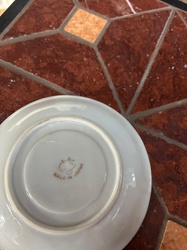
Regarding authenticity, the 'EST. 1840 old royal' reference strongly suggests a connection to a British pottery, likely 'Royal Albert' or a similar manufacturer established around that period, renowned for such intricate floral designs and gilded finishes. This style was highly popular throughout the late 19th and much of the 20th century. However, without a clear backstamp visible in the image, definitive attribution to a specific manufacturer like Royal Albert and its precise age cannot be fully confirmed. Many potteries produced similar 'Royal' themed ware.
In terms of market conditions, vintage demitasse sets, especially those with attractive floral patterns and gilding, generally see stable demand among collectors of teaware and dinnerware. However, the market is not experiencing a significant surge, and many such pieces are available. The rarity of this specific pattern or maker (if it were a less common 'Royal' company) could influence its desirability, but without a clear maker's mark, it's valued more as a well-preserved decorative vintage piece.
Factors impacting value include its good condition and pleasing aesthetic. However, the lack of a clearly identifiable specific maker's mark or pattern name significantly limits its top-tier collectible value. Comparable pieces by well-known manufacturers in similar condition typically range from $40 to $80, while generic vintage sets might fetch slightly less. My valuation reflects this typical market range for an attractive, good-condition vintage demitasse set, without definitive manufacturer identification.
For full authentication, an in-person examination would be crucial to inspect for maker's marks, specific pattern identifiers, and to verify the material (bone china vs. porcelain) and exact condition. Provenance documentation, if available, would also greatly assist in confirming its history and origin.