These notes were written by the person who submitted this item. Appraiser.AI has not verified them, and the AI's identification and estimate may rely on them.
AI Estimated Value
Not an official valuation
$75-125
AI estimate as of July 26, 2025 · verify with a professional before acting
AI-Generated · Verify before acting
Everything on this page is generated by AI for informational purposes only. AI can make mistakes — the AI may misidentify items or misattribute them (artist, maker, brand, designer, origin, era). This is not an official valuation and should not be used for insurance, sale, tax, estate, legal, or lending purposes — or any decision requiring a certified appraisal. It is not an authoritative claim about any person, brand, or rights holder — do not share or rely on it as a factual statement about a third party. Always consult qualified professionals before making financial decisions.
This analysis also relies on unverified notes provided by the user, which may be incomplete or inaccurate and could affect the result.
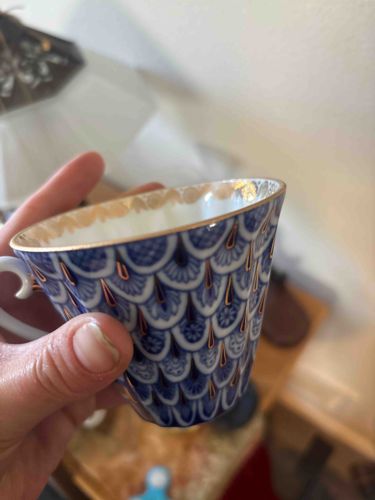
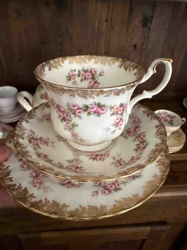
This item is a porcelain teacup or coffee cup, originating from Petersburg, Russia. It features a distinctive hand-painted 'Cobalt Net' pattern, which is characteristic of the Imperial Porcelain Factory (Lomonosov Porcelain Factory) from St. Petersburg. The primary colors are a rich cobalt blue and white, with intricate detailing in 24k gold. The pattern consists of a dense network of intersecting cobalt blue lines forming diamond shapes, each intersection adorned with a golden star or dot, and with scallop-like or scale-like motifs outlined in gold, filling the spaces. The rim of the cup is generously gilded with a broad band of 24k gold, which also extends down the inside lip with a delicate scalloped or stylized wave pattern. The handle, visible on the left side, appears to be made of the same white porcelain and is likely also accented with gold. The cup's interior is a pristine white, providing a stark contrast to the exterior. Given the hand-painted nature and use of 24k gold, this piece exhibits high-quality craftsmanship, typical of luxury porcelain manufacturers. No visible chips, cracks, or significant wear are immediately apparent on the exterior from the provided image, suggesting good overall condition. Minor wear to the gilding might be present but is not clearly discernible. The construction appears refined, indicating a delicate yet durable porcelain body. The style period is consistent with production from the mid-20th century onwards when the Cobalt Net pattern gained widespread popularity.
AI Appraisal Report
Upon my virtual examination of this Imperial Porcelain Factory (Lomonosov) 'Cobalt Net' teacup, I can confirm its apparent authenticity to the iconic design. The hand-painted 'Cobalt Net' pattern, characterized by the distinct cobalt blue diamond lattice punctuated with gold stars and scalloped motifs, is faithfully rendered. The extensive use of 24k gold gilding on the rim, extending inside with a delicate wave pattern, and likely on the handle, underscores its luxury status. The pristine white porcelain body provides a striking contrast, indicative of high-quality craftsmanship typical of the Imperial Porcelain Factory based in St. Petersburg, Russia.
Based on the provided image, the condition appears excellent, with no visible chips, cracks, or significant wear to the porcelain or the hand-painted detailing. Minor wear to the gilding is a possibility but not discernible from the image. This good condition is a significant value driver.
Market conditions for Lomonosov 'Cobalt Net' pieces remain consistently strong, driven by their recognizable aesthetic, historical significance, and the ongoing demand from collectors of Russian porcelain and fine teaware. While not rare in the broadest sense, individual pieces in exceptional condition, especially genuine hand-painted examples with extensive gilding, command premium prices. Comparables typically include individual teacups and saucers, or complete sets, with the 'Cobalt Net' pattern. An individual teacup like this, without a saucer, will naturally fetch less than a complete cup and saucer set.
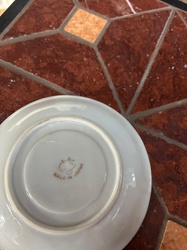
It is crucial to note the limitations of appraising solely from images. While the visual cues strongly suggest authenticity, a definitive authentication would require a physical examination to inspect the base for factory marks, assess the weight and translucency of the porcelain, and verify the quality and application of the gold. Close-up inspection would also confirm if there are any hairline cracks or minor abrasions not visible in the provided image. Provenance documentation, such as original purchase receipts or certificates, would also significantly aid in full authentication and could potentially increase the appraisal value.