AI estimate as of December 10, 2025 · verify with a professional before acting
AI-Generated · Verify before acting
Everything on this page is generated by AI for informational purposes only. AI can make mistakes — the AI may misidentify items or misattribute them (artist, maker, brand, designer, origin, era). This is not an official valuation and should not be used for insurance, sale, tax, estate, legal, or lending purposes — or any decision requiring a certified appraisal. It is not an authoritative claim about any person, brand, or rights holder — do not share or rely on it as a factual statement about a third party. Always consult qualified professionals before making financial decisions.
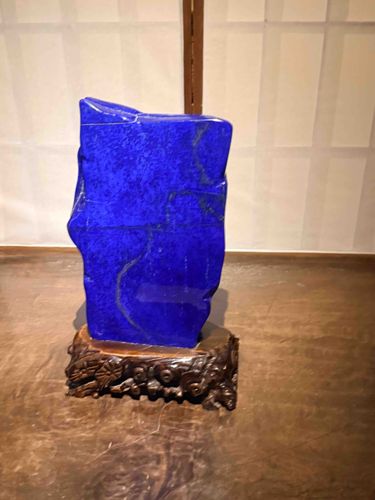
This item is a decorative mineral specimen featuring a substantial chunk of Lapis Lazuli, presented on a custom-carved wooden stand. The Lapis Lazuli itself is a vibrant, intense royal blue, exhibiting the characteristic deep coloration for which the mineral is prized. Its surface appears to be polished, giving it a somewhat lustrous finish that reflects light. The stone retains a largely organic, asymmetrical, and somewhat blocky shape, suggesting it is a raw or roughly shaped specimen rather than a finely sculpted object. Visible within the deep blue are subtle veins and speckles of lighter blue, and crucially, inclusions of metallic gold-colored pyrite, which are characteristic of natural high-quality lapis. There are also darker, almost black, linear inclusions or fractures, which could be natural matrix or veining within the stone. These inclusions add to the natural beauty and authenticity of the piece. The physical dimensions appear to be considerable, likely making this a prominent display item. It sits securely on a dark brown, possibly rosewood or mahogany, custom-carved wooden stand. The stand features intricately carved, organic motifs, possibly floral or cloud-like patterns, demonstrating skilled craftsmanship. The rich, dark color of the stand provides a strong contrast and elegant base for the bright blue stone. No visible condition issues like chips or cracks are apparent on the lapis from the image, and the wooden stand also appears to be in good condition without significant damage. The overall aesthetic suggests an item of decorative art, possibly from an Asian artistic tradition given the style of the wood carving, and of a relatively modern era or a revival of traditional styles. The quality of the lapis, especially its rich color and pyrite flecks, indicates a valuable specimen.
AI Appraisal Report
Based on my visual examination of the provided image, this Lapis Lazuli Specimen on Carved Wooden Stand presents as a high-quality decorative art piece. The Lapis Lazuli itself is of exceptional quality, displaying a vibrant, intense royal blue color, characteristic of premium Afghani lapis, and contains clear inclusions of metallic golden pyrite, which are highly desirable and indicate authenticity. The polished surface enhances its visual appeal. The presence of darker linear inclusions is consistent with natural matrix or veining within genuine lapis. The custom-carved wooden stand is a significant contributor to the item's value, showcasing intricate organic motifs and skilled craftsmanship, likely Asian in origin, which elevates the piece beyond merely a mineral specimen. The condition appears excellent; I observe no chips, cracks, or significant damage to either the lapis or the stand from the image.
Market conditions for high-quality mineral specimens, especially those presented as decorative art, are strong. Comparables often include natural lapis lazuli sculptures or large polished specimens mounted on custom bases, as well as antique or contemporary Asian carved wooden stands. The combination of a substantial, high-grade lapis lazuli and a finely carved stand creates a unique and appealing item. Demand for natural, aesthetically pleasing mineral art is consistent, and specimens with good color, size, and minimal matrix, like this one, are sought after. The intricate carving of the stand adds to its rarity and artistic merit. Factors impacting value positively include the rich color, size, and pyrite inclusions of the lapis, and the craftsmanship of the stand.
Limitations in authenticity verification from images alone exist. While the visual indicators for genuine lapis lazuli (color, pyrite inclusions, natural veining) are strong, an in-person examination would be crucial to confirm the absence of artificial dyes or enhancements, assess the exact weight and stability of the specimen, and thoroughly inspect the wood for material type and age. Provenance documentation, detailing the origin of the lapis and the stand, would significantly enhance authentication and value. Scientific testing could definitively confirm mineral composition if any doubt arose about the lapis. Without physical inspection, I must rely solely on photographic evidence for this appraisal.