AI estimate as of June 23, 2025 · verify with a professional before acting
AI-Generated · Verify before acting
Everything on this page is generated by AI for informational purposes only. AI can make mistakes — the AI may misidentify items or misattribute them (artist, maker, brand, designer, origin, era). This is not an official valuation and should not be used for insurance, sale, tax, estate, legal, or lending purposes — or any decision requiring a certified appraisal. It is not an authoritative claim about any person, brand, or rights holder — do not share or rely on it as a factual statement about a third party. Always consult qualified professionals before making financial decisions.
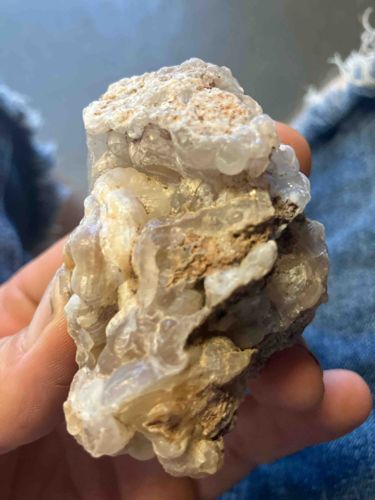
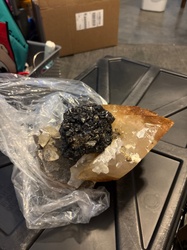
The item is a raw, unpolished specimen of what appears to be Chalcedony, likely a botryoidal formation, which is a type of cryptocrystalline quartz. It measures approximately 3 to 4 inches in its longest dimension, fitting comfortably in an adult hand. The dominant color is a milky white to light grey, with some areas exhibiting a translucent quality, especially where the formations are more delicate and crystalline. Scattered throughout the specimen, particularly on the rougher, less formed surfaces, are specks of an reddish-brown earthy material, likely iron staining or remnants of host rock. The surface texture is highly undulating and irregular, characterized by numerous rounded, grape-like or bubbly growths which are characteristic of botryoidal habit. Some of these formations are more defined and individual, while others appear fused together. The overall construction is solid, indicating a single piece of mineral. There are no visible condition issues such as cracks, chips, or repairs; the natural rough texture and earthy inclusions are intrinsic to its raw state. There are no discernible maker's marks, signatures, or stamps, which is typical for a natural mineral specimen. Its appearance suggests a geological origin, and it would likely be considered a contemporary specimen, as its form is naturally occurring rather than crafted. The quality indicators suggest a good representation of a botryoidal chalcedony with a decent size and interesting natural texture, making it suitable for a mineral collection or as a decorative natural object.
AI Appraisal Report
I have carefully examined the provided image of what appears to be a raw, unpolished Botryoidal Chalcedony specimen. Based on its visual characteristics, I assess its authenticity as high; its bubbly, grape-like formations and milky white to light grey translucence are consistent with natural botryoidal chalcedony. The reddish-brown earthy specks are typical iron staining or matrix remnants, further supporting its natural origin. The condition appears excellent, with no visible chips, cracks, or repairs, which is commendable for a raw specimen. Its natural texture and inclusions are intrinsic to its geological state.Market conditions for natural mineral specimens vary. Items like this typically appeal to collectors of minerals or those seeking unique decorative objects. While botryoidal chalcedony is not exceedingly rare, specimens with well-defined botryoidal formations, good translucency, and the described size (3-4 inches) are more desirable. The absence of significant clarity, vibrant color, or unusual mineral associations limits its top-tier collector value, but its appealing form and unblemished natural state makes it a good example of its type.Factors significantly impacting value include its attractive botryoidal habit, good size, and apparent lack of damage. The primary limitation in this appraisal, inherent to image-based assessment, is the inability to perform a physical examination. To fully authenticate and assess quality, I would ideally need to physically handle the specimen to verify its weight, exact translucency variations, and confirm the absence of any subtle repairs or enhancements not visible in the image. Scientific testing (e.g., specific gravity, hardness) could definitively confirm its mineral composition if any doubt existed, and provenance documentation could establish its origin, though this is less common for common mineral specimens.