AI Appraisal Estimate

AI-generated estimates · not official valuations

From the user

What was submitted

Photo and notes provided by the user — not generated by AI

Submitted item photo
Submitted photo · June 24, 2026

User's notes

No additional notes provided.

AI analysis below

AI appraisal

AI analysis & estimate

AI-Generated · Verify before acting

Everything below is generated by AI for informational purposes only. AI can make mistakes — the AI may misidentify items or misattribute them (artist, maker, brand, designer, origin, era). This is not an official valuation and should not be used for insurance, sale, tax, estate, legal, or lending purposes — or any decision requiring a certified appraisal. It is not an authoritative claim about any person, brand, or rights holder — do not share or rely on it as a factual statement about a third party. Always consult qualified professionals before making financial decisions.

Read the full disclaimer

AI Identification

·Not independently authenticated·Verify before acting

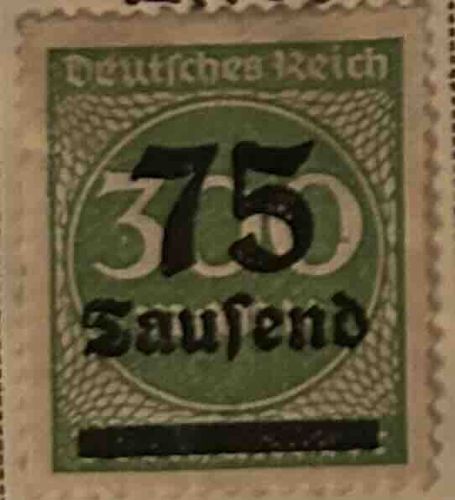
German Inflation Period Postage Stamp (75 Tausend Mark)

Postage Stamp

AI Estimated Value

·Not an official valuation·Verify before acting

$0.50 - $2.00

As of June 24, 2026

AI Item Analysis

·AI can make mistakes·Verify before acting
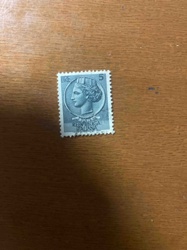
This item is a German postage stamp from the inflation period, likely early 1920s. The stamp is predominantly green and features a square design with perforations along all four edges, indicating it was intended to be detached from a larger sheet. The central motif is a large circular shape, also in green, providing a background for the denomination. Prominently displayed within this circle are the numbers '75' in a dark, possibly black or very dark green, bold font, signifying the value. Below the '75', the word "Tausend" (German for 'thousand') is written in a similar dark, calligraphic or Gothic-style font. Above the central circle, across the top border of the stamp, the text "Deutsches Reich" (German for 'German Empire' or 'German Realm') is visible in a somewhat lighter, stylized font. The background of the outer square design appears to have a fine, cross-hatched or woven pattern. The overall color scheme is green with dark text, characteristic of many stamps from this era. The perforations appear relatively clean, suggesting it was carefully separated from a sheet. There are no obvious tears or major creases, though slight yellowing or toning consistent with age is perceptible, particularly around the edges and in the white of the perforations. The image quality makes it difficult to discern exact paper type or watermarks, but the visible details point to it being a standard printed postage stamp of the period, reflecting the extreme hyperinflation experienced in Germany at the time.
AI Appraisal Report

·AI can make mistakes·Verify before acting
I have examined the image of the German Inflation Period 75 Tausend Mark postage stamp. Based on visual assessment, the stamp appears authentic for its type, displaying typical design elements, denomination, and 'Deutsches Reich' inscription consistent with German hyperinflation-era issues. The condition appears to be 'Fine-Very Fine' for a used stamp of this period. The perforations are reasonably clean, and there are no obvious tears or significant creases. Slight toning or yellowing is visible, which is common and expected for a stamp of this age. The printing appears clear, and the overall aesthetic is good, though the image quality limits detailed examination of the paper and finer printing details. Market conditions for German hyperinflation stamps are generally modest. While historically significant, these stamps were produced in enormous quantities, making most denominations relatively common. The 75 Tausend Mark stamp is a very common issue. Comparable examples in similar circulated condition typically sell for under a few dollars. Demand is primarily from general German stamp collectors or those seeking representative examples of the inflation period, rather than high-end philatelic investors. Rarity is low due to the sheer volume printed. Factors impacting value negatively are the high availability and the fact that it is a common denomination. Conversely, its historical context is its main appeal. It is critical to note that a definitive authentication and precise condition grading cannot be fully completed from an image alone. An in-person examination would be necessary to check for subtle printing variations, paper characteristics (e.g., watermarks, paper type, damage not visible in the image), gum condition (if unused), and potential repairs or alterations. Provenance documentation, while helpful for higher-value items, is less critical for common issues like this one. Scientific testing is generally not applied to stamps of this value.

Get your items appraised

Instant estimates of your treasures with AI-powered appraisals

Browse More Appraisals