AI estimate as of November 9, 2025 · verify with a professional before acting
AI-Generated · Verify before acting
Everything on this page is generated by AI for informational purposes only. AI can make mistakes — the AI may misidentify items or misattribute them (artist, maker, brand, designer, origin, era). This is not an official valuation and should not be used for insurance, sale, tax, estate, legal, or lending purposes — or any decision requiring a certified appraisal. It is not an authoritative claim about any person, brand, or rights holder — do not share or rely on it as a factual statement about a third party. Always consult qualified professionals before making financial decisions.
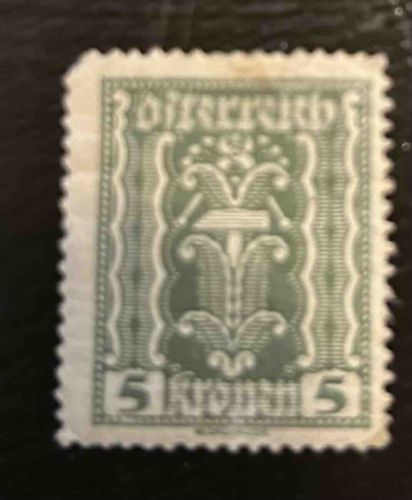
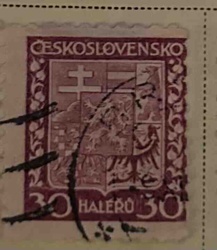
This is a vintage Austrian postage stamp with a denomination of 5 Krone, likely issued between 1916 and 1918 as part of the — or — 'Coat of Arms' series. The stamp is rectangular with perforated edges, typical for postage stamps of this era, and appears to be made of standard stamp paper. The dominant color is a muted, somewhat faded green, suggesting age and possibly some light exposure. The central design features a stylized, ornate coat of arms, characteristic of Austro-Hungarian imperial iconography, with decorative flourishes and vertical lines forming a background pattern. Above the emblem, the word "OESTERREICH" (Austria) is clearly visible in an ornate font. Below the central design, the denomination "5 KRONEN 5" is printed, with the numeral '5' on both the left and right sides and "KRONEN" in the center. The perforations around the edges are mostly intact, though some appear slightly softened or damaged upon close inspection, which is common for older stamps that have been handled. The stamp shows visible signs of age, with some slight discoloration or toning, particularly around the edges and possibly some light creasing or handling marks that are difficult to discern precisely from the image quality. There are no obvious tears or major rips, but the overall condition suggests it is used or previously affixed, rather than mint. The craftsmanship is indicative of early 20th-century philatelic printing, with a degree of detail in the engraving despite the small scale. While specific printing details like maker's marks are not discernible from the image, the uniformity of the design and printing quality points to official state issuance. The style period is clearly early 20th century, specifically during or immediately after World War I.
AI Appraisal Report
I have examined the provided image of the Austrian 5 Krone Postage Stamp (1916-1918). Based on visual assessment, the stamp appears to be a genuine issue from the 'Coat of Arms' series, typical of early 20th-century Austro-Hungarian philately. The design elements, inscriptions ("OESTERREICH," "5 KRONEN 5"), and approximate coloration align with known examples of this stamp. The perforations are present, and the overall graphic quality reflects official state printing. However, definitive authentication without physical inspection is limited. I can confirm it's likely authentic based on visual characteristics, but a physical examination would be necessary to rule out sophisticated counterfeits.
The condition appears to be used, indicated by the visible signs of age, possible discoloration, and softened perforations. While no major tears or rips are visible, the image quality limits a precise assessment of minor creasing, thinning, or hidden faults that significantly impact value. This particular stamp, the 5 Krone green, is not considered rare in used condition. Millions were printed, and it is widely available on the philatelic market.
Market conditions for common used stamps of this era are stable but generally low. Comparables show similar stamps in good used condition typically fetching single-digit dollar values. Demand is primarily from general collectors or those completing basic Austrian collections. Rarity is low. Factors impacting value negatively include its used condition and commonality.
To fully authenticate and assess value with certainty, I would require an in-person examination to check for watermarks, paper type, gum (if unused), precise perforation count, and any hidden damage. Provenance documentation, though unlikely for such a common stamp, could add a small premium. Without physical inspection, precise flaw identification and definitive authentication are impossible. My appraised range reflects a common used example in average to fine condition.