AI estimate as of November 9, 2025 · verify with a professional before acting
AI-Generated · Verify before acting
Everything on this page is generated by AI for informational purposes only. AI can make mistakes — the AI may misidentify items or misattribute them (artist, maker, brand, designer, origin, era). This is not an official valuation and should not be used for insurance, sale, tax, estate, legal, or lending purposes — or any decision requiring a certified appraisal. It is not an authoritative claim about any person, brand, or rights holder — do not share or rely on it as a factual statement about a third party. Always consult qualified professionals before making financial decisions.
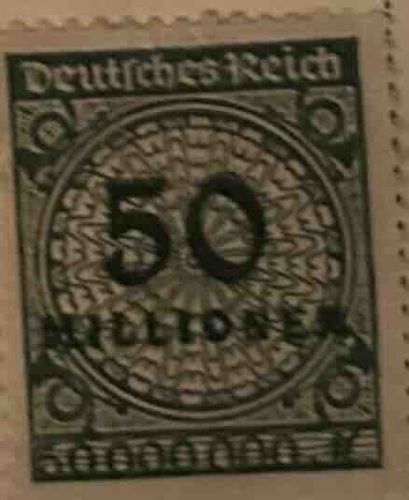
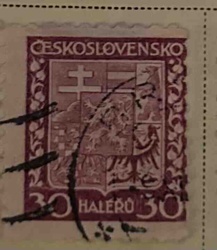
This item is a postage stamp from the German hyperinflation period, specifically valued at '50 Millionen' (50 Million) Mark. The stamp features a dark green or blue-green ink on what appears to be a light, possibly off-white or beige, paper. The design is characteristic of that era, with 'Deutsches Reich' (German Empire) printed across the top in a Gothic-style font. A large numeral '50' dominates the center of the stamp, overlaid on an intricate guilloche pattern within a circular frame. Below the '50', the word 'MILLIONEN' is prominently displayed, confirming the denomination. At the very bottom, another numerical value, '50000000', is printed, further elucidating the massive face value. The stamp exhibits perforation along all four edges, indicating it was part of a larger sheet and intended for postal use. The overall condition appears to be used or possibly unused with some slight aging. There are no obvious tears or major creases, though the image quality makes it difficult to assess minor imperfections or hinge marks. The style is indicative of early 20th-century German philately, dating specifically to the height of the hyperinflation crisis in Germany, likely around 1923. The ink appears consistent and well-applied, suggesting typical printing quality for government-issued postage at the time, despite the economic turmoil. The design is functional, emphasizing the denomination due to the rapidly changing monetary values.
AI Appraisal Report
Based on my visual examination of the provided image, this German Hyperinflation Stamp, 50 Millionen Mark, appears to be an authentic example from the 1923 period. The design, including the 'Deutsches Reich' inscription, Gothic font, large '50' with 'MILLIONEN' below, and the '50000000' numerical value, is consistent with known issues from that era, specifically Scott #306 (or Michel #300). The dark green ink on light paper and perforation along all edges are also typical characteristics. The stamp's condition appears to be used or hinged, given the context, with no apparent major tears or creases, though minor imperfections or hinging cannot be definitively ruled out without a higher-resolution image or physical inspection.
Authenticity: While the visual elements strongly suggest authenticity, definitive verification without physical inspection is challenging. Factors such as paper type, watermarks (if any), precise ink color, and printing anomalies cannot be fully assessed from an image.
Market Conditions & Comparables: Stamps from the German hyperinflation period, particularly common denominations like this 50 Million Mark issue, are readily available. Millions were printed, making them relatively common. Similar examples in used condition typically trade for modest sums.
Demand & Rarity: Demand is generally stable among collectors of German philately, but the common nature of this specific denomination means it is not rare. Its historical significance is greater than its monetary value in most cases.
Factors Impacting Value: Condition is paramount. A crisp, unused, unhinged example (MNH - Mint Never Hinged) would command a higher price. Any damage, creasing, or heavy cancellation reduces value. Rarity of specific plate flaws or varieties can also increase value but cannot be determined from this image.
Limitations: For full authentication and a more precise valuation, a physical examination would be crucial. I would need to assess the paper, check for watermarks, examine the gum (if unused), and scrutinize the printing details under magnification. Provenance documentation (e.g., certificates of authenticity from reputable philatelic organizations) would also enhance confidence in its authenticity and condition.