AI estimate as of November 8, 2025 · verify with a professional before acting
AI-Generated · Verify before acting
Everything on this page is generated by AI for informational purposes only. AI can make mistakes — the AI may misidentify items or misattribute them (artist, maker, brand, designer, origin, era). This is not an official valuation and should not be used for insurance, sale, tax, estate, legal, or lending purposes — or any decision requiring a certified appraisal. It is not an authoritative claim about any person, brand, or rights holder — do not share or rely on it as a factual statement about a third party. Always consult qualified professionals before making financial decisions.
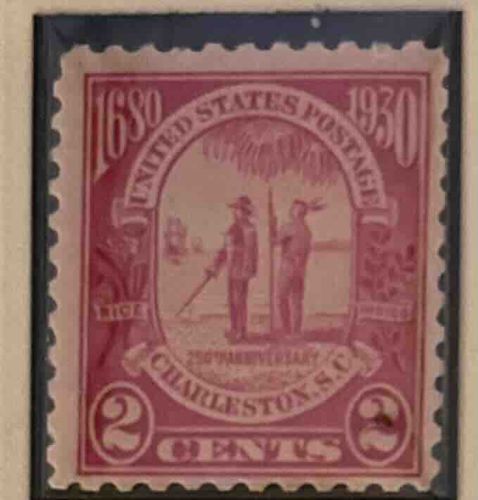
This is a 2-cent United States postage stamp, commemorating the 250th Anniversary of Charleston, South Carolina, issued in 1930. The stamp features a predominantly monochrome reddish-purple color scheme, a common hue for definitive and commemorative stamps of that era. The central vignette depicts two figures, one appearing to be a European settler or explorer in period attire, holding what might be a musket or staff, and the other an indigenous person, possibly a Native American, holding a spear. They stand in a landscape setting with what looks like water and sailing ships in the background, under palm-like trees. The central image is enclosed within an oval frame. Above this frame, in an arch, are the words 'UNITED STATES POSTAGE'. The years '1680' and '1930' are prominently displayed in large numerals on the upper left and right corners, respectively, indicating the anniversary dates. A banner at the bottom of the central oval reads '250th ANNIVERSARY' and below that, curved text says 'CHARLESTON, S.C.'. The denomination '2 CENTS' is clearly printed at the very bottom center, with the numeral '2' also present in ornate circles in the lower left and right corners. The stamp is perforated along all four edges, indicating it was part of a sheet. It appears to be housed within a dark border or frame, which may be a protective mount or part of an album. The condition appears to be relatively good, with no obvious major tears or creases, although the image resolution makes it difficult to assess fine details like paper quality or gum integrity. The impression seems clear and well-inked, typical of US postal issues of the early 20th century.
AI Appraisal Report
Upon visual examination of the provided image of the 1930 Charleston, South Carolina 250th Anniversary 2-cent stamp, I observe an item that appears to be authentic based on the design, colors, and inscriptions consistent with known examples of Scott #685. The perforations appear intact on all four sides, and the centering seems reasonably good for the issue. I detect no immediate signs of major tears, creases, or significant staining. The image resolution, however, prevents a definitive assessment of finer details such as expert grille marks, paper characteristics, gum condition (if unused), or subtle creasing and thinning. This stamp is very common. It was issued in large quantities (over 65 million printed) and is readily available in both unused and used condition. Market conditions show consistent, low demand for common examples, with prices primarily driven by subtle differences in centering, gum condition (for unused), and cancellation quality (for used). Superb, perfectly centered, unused examples with full original gum might fetch the higher end of the range, while typical used examples with minor faults or heavy cancellations will be on the lower end. The primary factor impacting value for this specific stamp is its commonality. Without an in-person examination, I cannot confirm the presence of original gum, re-gumming, repairs, thins, or hidden faults. A physical inspection would be necessary to verify gum condition, precise centering, absence of hidden faults, and to apply an accurate grade. Examination under magnification would reveal paper texture, ink vibrancy, and any subtle alterations. Authentication from images alone is always limited; a physical inspection by a philatelic expert is required for full authentication and an accurate, definitive grade.