These notes were written by the person who submitted this item. Appraiser.AI has not verified them, and the AI's identification and estimate may rely on them.
AI Estimated Value
Not an official valuation
$25-45
AI estimate as of July 14, 2025 · verify with a professional before acting
AI-Generated · Verify before acting
Everything on this page is generated by AI for informational purposes only. AI can make mistakes — the AI may misidentify items or misattribute them (artist, maker, brand, designer, origin, era). This is not an official valuation and should not be used for insurance, sale, tax, estate, legal, or lending purposes — or any decision requiring a certified appraisal. It is not an authoritative claim about any person, brand, or rights holder — do not share or rely on it as a factual statement about a third party. Always consult qualified professionals before making financial decisions.
This analysis also relies on unverified notes provided by the user, which may be incomplete or inaccurate and could affect the result.
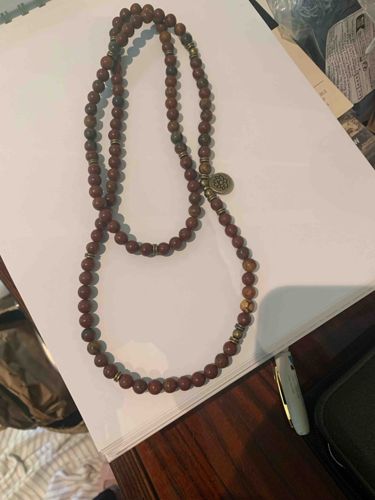
This item is a long strand of beads, likely a mala or prayer beads given its length and construction. The beads are predominantly a reddish-brown color, consistent with types of jasper or other natural stones often used in such practices. Many of the beads exhibit slight variations in hue, with some showing subtle darker specks or lighter, more mottled areas, suggesting natural stone rather than uniform manufactured material. The beads are spherical and appear to be largely uniform in size, estimated to be between 6mm and 8mm in diameter each. They are strung on a visible cord, which appears to be a durable thread, possibly waxed or nylon, in a complementary dark color.
Interspersed among the reddish-brown beads are several antique brass or bronze-toned metal spacer beads. These spacers are small, cylindrical, and have a slightly textured or aged appearance, suggesting an intentional antique finish rather than significant wear. A notable feature is a larger, circular metal charm or medallion, also in an antique brass/bronze tone, attached approximately one-third of the way down the strand from one end. This charm features an intricate, symmetrical floral or geometric design, possibly a stylized lotus or mandala, signifying spiritual or cultural importance.
The overall condition appears good, with no obvious signs of significant damage, breaks, or missing beads. The metal components show a consistent patina indicative of their intended aged look, rather than heavy tarnish or corrosion. The bead surfaces appear smooth and polished. Due to the natural variations in the stone and the antique finish on the metal, it's difficult to pinpoint specific manufacturing marks without closer inspection, but the craftsmanship suggests a mass-produced item with a focus on a spiritual aesthetic. The style period is contemporary, aiming for a rustic or artisanal look, likely produced within the last 10-20 years. The combination of natural stone beads and metal accents indicates a modest to good quality item, suitable for personal wear or use in spiritual practices.
AI Appraisal Report
Upon examination of the provided images, this item is identified as a contemporary set of mala or prayer beads. The beads, estimated at 6-8mm, are a reddish-brown stone, exhibiting natural color variations consistent with a material like red jasper, although this cannot be definitively confirmed visually. The overall condition appears to be very good, with no discernible chips, cracks, or missing components. The strand is accented with antique-finished metal spacer beads and a larger medallion, possibly brass or bronze, featuring a stylized floral or mandala design. This aesthetic is common in mass-produced spiritual jewelry from the last 10-20 years.
The item's value is primarily determined by its materials and craftsmanship rather than age or rarity. The market for similar contemporary mala beads is quite saturated. Comparable items made with common stones like red jasper and base metal accents typically retail in a modest price range. The perceived value lies in its spiritual or decorative use. Without a physical inspection, it is impossible to conclusively identify the specific stone or metal alloy. A gemological test would be required to confirm the stone's identity, and a metallurgical test for the metal content. Provenance or a maker's mark could elevate its value, but none are visible. Lacking evidence of precious metals, significant age, or a high-end designer, the piece is appraised as a well-made, decorative, and functional accessory.