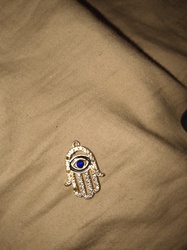
These notes were written by the person who submitted this item. Appraiser.AI has not verified them, and the AI's identification and estimate may rely on them.
AI Estimated Value
Not an official valuation
$60-90
AI estimate as of July 12, 2025 · verify with a professional before acting
AI-Generated · Verify before acting
Everything on this page is generated by AI for informational purposes only. AI can make mistakes — the AI may misidentify items or misattribute them (artist, maker, brand, designer, origin, era). This is not an official valuation and should not be used for insurance, sale, tax, estate, legal, or lending purposes — or any decision requiring a certified appraisal. It is not an authoritative claim about any person, brand, or rights holder — do not share or rely on it as a factual statement about a third party. Always consult qualified professionals before making financial decisions.
This analysis also relies on unverified notes provided by the user, which may be incomplete or inaccurate and could affect the result.
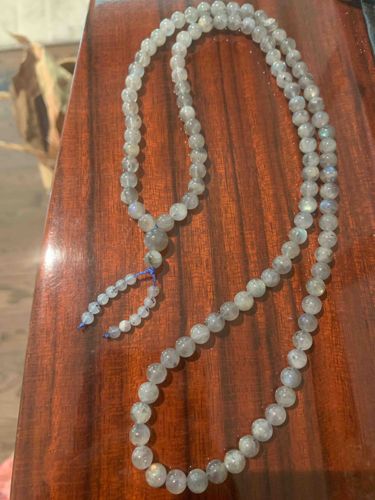
This item is a string of polished, spherical beads, appearing to be a mala or prayer beads, crafted from what is commonly known as Labradorite, a feldspar mineral. The beads exhibit a characteristic optical phenomenon called labradorescence, where flashes of iridescent blue, green, and occasionally purple play across their surfaces when viewed from different angles, particularly noticeable in several beads throughout the string. Each bead is relatively uniform in size, estimated to be approximately 6-8mm in diameter, with a smooth, polished finish. The color of the beads themselves is a translucent to opaque light grey or off-white, allowing the ethereal flashes of color to stand out. The string appears to be hand-knotted between each bead with a thin, light-colored thread, a common practice in mala construction to provide durability and a distinct feel for counting prayers or mantras. A larger, more prominent 'guru' or 'meru' bead is visible at one end of the main strand, distinguishing it from the rest, with a small, tassel-like strand branching off it, composed of smaller beads strung on a blue cord. This smaller strand includes an additional approximately 8-10 beads of decreasing size, ending in a knot with what appears to be a blue thread tassel. The overall condition appears very good, with no visible chips, cracks, or significant abrasions on the beads. The polish is consistent, suggesting well-maintained craftsmanship. The stringing appears secure, and the knots show no signs of fraying or weakening. Given its construction and the type of stone, this piece is likely a contemporary creation, perhaps within the last 20-30 years, designed for contemplative or spiritual practice, or as a decorative necklace.
AI Appraisal Report
Upon examination of the provided images and description, I have evaluated this string of what is presented as Labradorite mala beads. The beads, estimated at 6-8mm in diameter, are hand-knotted, consistent with traditional mala construction. The primary value driver for this piece is the quality of the labradorite, specifically the intensity and coverage of its labradorescence. Several beads display a desirable play-of-color, with flashes of blue and green, which is characteristic of the stone. The overall condition appears to be very good, with no visible damage to the beads and intact knotting. The market for spiritual jewelry and tools like this is well-established but can be saturated. Comparable, new-production labradorite malas of similar size and apparent quality are widely available online and in specialty shops, with prices typically ranging from $40 to over $150, depending on the vibrancy of the stones and the craftsmanship. This piece, being a contemporary creation likely made in the last 20-30 years, falls within this secondary market. Its value is influenced by the perceived quality of the labradorescence and its appeal as a functional spiritual tool or decorative necklace rather than its rarity.
It is crucial to note the limitations of an appraisal based solely on images. Without physical inspection, I cannot definitively confirm the material is natural, untreated labradorite versus a synthetic or treated alternative. An in-person examination would be required to test the stones' properties, assess the quality of the knotting and thread, and more accurately gauge the depth and brilliance of the labradorescence across all beads, which significantly impacts value.