Chinese Style Celadon Jade Dragon C-Pendant
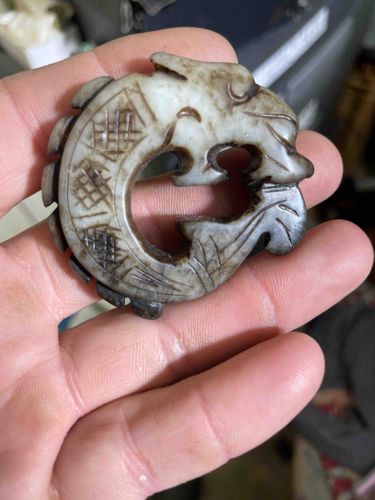
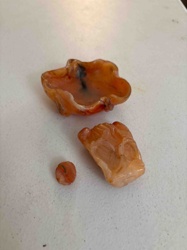
A hand-carved jade or nephrite pendant meticulously shaped into an archaic 'C-shaped' dragon or 'pig dragon' (Zhulong) motif, characteristic of designs from the Hongshan culture. The item is approximately 2 to 2.5 inches in diameter, featuring a pale celadon or grayish-white base stone. It exhibits significant surface calcification, earthy inclusions, and a dark brown to blackish patina within the recessed carvings, which suggests an attempt to replicate an ancient buried appearance. The carving displays traditional iconography including large circular eyes, a prominent snout, and a stylized mane or dorsal fin. The body is decorated with incised cross-hatched diamond patterns and linear grooves. Condition-wise, the piece shows intentional distressing, minor surface abrasions, and deep-set oxidation. While modeled after Neolithic period artifacts, the quality of some of the sharper incised lines and the specific nature of the surface staining may indicate a contemporary or 20th-century artisanal reproduction meant for the collector market rather than an authenticated archaeological find. The craftsmanship shows a mix of hand-finishing and potential mechanical tooling in the deeper penetrations.
AI-Generated Appraisal Disclaimer
Estimated Value
$100 - $300
Basic Information
Category
Asian Antiques & Decorative Arts
Appraised On
December 23, 2025
Estimated Value
$100 - $300
Item Description
A hand-carved jade or nephrite pendant meticulously shaped into an archaic 'C-shaped' dragon or 'pig dragon' (Zhulong) motif, characteristic of designs from the Hongshan culture. The item is approximately 2 to 2.5 inches in diameter, featuring a pale celadon or grayish-white base stone. It exhibits significant surface calcification, earthy inclusions, and a dark brown to blackish patina within the recessed carvings, which suggests an attempt to replicate an ancient buried appearance. The carving displays traditional iconography including large circular eyes, a prominent snout, and a stylized mane or dorsal fin. The body is decorated with incised cross-hatched diamond patterns and linear grooves. Condition-wise, the piece shows intentional distressing, minor surface abrasions, and deep-set oxidation. While modeled after Neolithic period artifacts, the quality of some of the sharper incised lines and the specific nature of the surface staining may indicate a contemporary or 20th-century artisanal reproduction meant for the collector market rather than an authenticated archaeological find. The craftsmanship shows a mix of hand-finishing and potential mechanical tooling in the deeper penetrations.
Get Your Items Appraised
Instant estimates of your treasures with AI-powered instant appraisals