AI estimate as of July 11, 2025 · verify with a professional before acting
AI-Generated · Verify before acting
Everything on this page is generated by AI for informational purposes only. AI can make mistakes — the AI may misidentify items or misattribute them (artist, maker, brand, designer, origin, era). This is not an official valuation and should not be used for insurance, sale, tax, estate, legal, or lending purposes — or any decision requiring a certified appraisal. It is not an authoritative claim about any person, brand, or rights holder — do not share or rely on it as a factual statement about a third party. Always consult qualified professionals before making financial decisions.
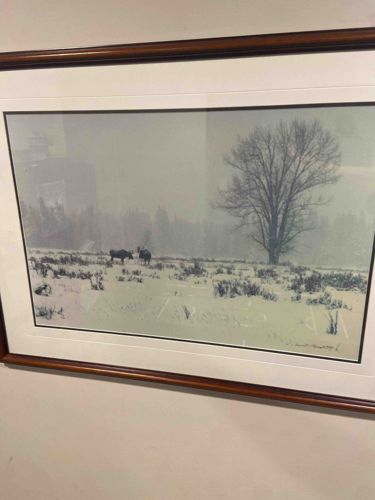
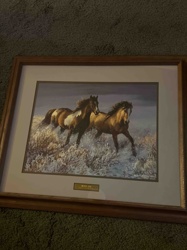
The item is a framed art print depicting a winter landscape with two large animals, likely moose, in a snowy field. The print is housed within a dark reddish-brown wooden frame with a visible grain, suggesting a natural wood finish or stain. The frame appears to have a simple, possibly rounded, profile. Surrounding the print is a wide, off-white mat board, providing a stark contrast to the darker hues of the artwork and aiding in its presentation. The artwork itself features a muted color palette dominated by whites, grays, and faint blues, characteristic of a snowy, overcast day. In the foreground and middle ground, snow covers the terrain, with darker, possibly evergreen, vegetation or brush visible poking through the snow. Two large, dark figures of animals are positioned in the mid-ground, appearing to be grazing or standing. To the right of the frame, a prominent bare deciduous tree with intricate branching dominates the right side of the composition, its dark silhouette standing out against the light sky. In the background, a hazy line of trees or hills is discernible. There is a visible signature or inscription in the bottom right corner of the print, though it is not clearly legible from the image provided. The print appears to be in good condition, with no overt signs of damage, fading, or tears visible. The frame also appears well-maintained, with no significant chips or scratches. The overall quality suggests a mass-produced art print, likely from the late 20th or early 21st century, designed for decorative purposes.
AI Appraisal Report
Upon visual examination of the provided image, this framed art print depicting a winter landscape with moose appears to be in very good condition. The print exhibits no visible tears, fading, or damage, and the colors appear largely intact, consistent with its likely age. The matting is clean and free from discoloration, and the wooden frame shows no significant chips or scratches, suggesting good care. There is a signature in the bottom right corner, which, while illegible from the image, points to it being an artist's print, though whether it is a limited edition or open edition cannot be determined visually. This appears to be a mass-produced decorative art print, likely from the late 20th or early 21st century.
Market conditions for such decorative art prints are generally stable but do not command high values unless attributed to a highly collected artist or being part of a rare limited edition. Comparables for similar framed landscape prints, often found in home decor stores, secondary art markets, or online marketplaces, typically range from modest prices. Demand for general decorative art is consistent, but rarity for these types of prints is low unless specific artist authentication or edition information is available. Factors significantly impacting value include the artist's reputation, the print's edition size (if signed and numbered), and the overall quality of the reproduction and framing materials.
Without physical examination, I cannot definitively verify the printmaking technique (e.g., lithograph, giclée), nor can I authenticate the artist's signature. Full authentication would require in-person examination to assess paper quality, print process, and a more thorough inspection of the signature. Provenance documentation, such as a certificate of authenticity or purchase receipts, would also be crucial, especially if attributed to a known artist. Scientific testing, such as ink analysis, is typically not warranted for items in this value range.