AI estimate as of July 8, 2025 · verify with a professional before acting
AI-Generated · Verify before acting
Everything on this page is generated by AI for informational purposes only. AI can make mistakes — the AI may misidentify items or misattribute them (artist, maker, brand, designer, origin, era). This is not an official valuation and should not be used for insurance, sale, tax, estate, legal, or lending purposes — or any decision requiring a certified appraisal. It is not an authoritative claim about any person, brand, or rights holder — do not share or rely on it as a factual statement about a third party. Always consult qualified professionals before making financial decisions.
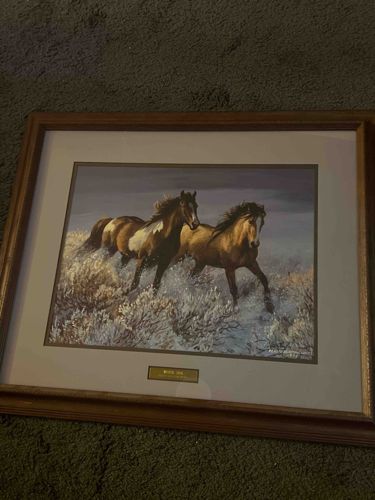
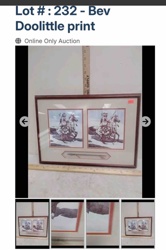
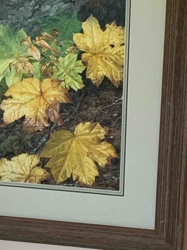
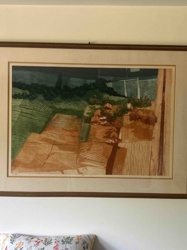
The item is a framed art print depicting two wild horses in a natural landscape. The print itself showcases dynamic brushstrokes, suggesting either a painting reproduction or a highly detailed digital artwork, with vibrant colors capturing the horses' coats and the surrounding vegetation. One horse appears to be a pinto with brown and white markings, while the other is a solid brown or dun color. Both horses are depicted in mid-stride, possibly running, which conveys a sense of motion and wild spirit. They are surrounded by light-colored, possibly snow-dusted or pale, bushy vegetation, set against a dark, stormy, or twilight sky. The print is housed within a classic wooden frame of a medium brown hue, exhibiting a simple, clean profile. The frame appears to be in good condition with minor visible wear consistent with age, such as slight scuffs or scratches. The artwork is protected by clear glazing, presumably glass or acrylic, which shows some reflections from the room but no obvious cracks or significant blemishes. A wide, light-colored mat board, likely an off-white or light gray, surrounds the print, providing a visual border and separation from the frame. Centered on the bottom portion of the mat, there is a small, rectangular brass-colored plaque that appears to have text, likely the title of the piece or the artist's name, though the text is not legible from the image. The overall presentation suggests a commercially produced art print, likely from the late 20th or early 21st century, designed for decorative purposes. The craftsmanship of the framing appears competent, indicating a standard quality for framed art prints.
AI Appraisal Report
Based on my visual examination of the provided image, this Wild Horses Framed Art Print appears to be a commercially produced decorative piece. The condition of the frame is good, showing minor scuffs consistent with age, while the glazing appears clear and free of significant blemish. The vibrant colors and dynamic portrayal of the horses suggest a quality reproduction.
Market conditions for decorative art prints like this are generally stable but do not typically command high values unless tied to a renowned artist or a limited-edition series with strong collector demand. The visible brass-colored plaque on the mat board indicates a potential title or artist's name, which, if legible, could influence value if it is by a recognized artist. However, without legibility, it is assumed to be a standard decorative offering.
Factors impacting value include the print's decorative appeal, the quality of framing, and its condition. Demand for art depicting wildlife, particularly horses, is consistent, but rarity is low for commercially produced prints. This item falls within the broad category of mass-market decor, which typically sells for modest sums compared to original artworks or limited editions by established artists.
My assessment is limited by the visual input alone. I cannot definitively ascertain the print's medium (e.g., offset lithograph, giclée), the artist's identity, or if it is part of a limited series. Full authentication would require in-person examination to assess print quality, frame construction, and to potentially identify the artist from the plaque. Provenance documentation, if available, would further verify its origin and potential value beyond a decorative piece. Scientific testing of materials would be unnecessary for a typical decorative print of this nature.