These notes were written by the person who submitted this item. Appraiser.AI has not verified them, and the AI's identification and estimate may rely on them.
AI Estimated Value
Not an official valuation
$300-500
AI estimate as of July 19, 2025 · verify with a professional before acting
AI-Generated · Verify before acting
Everything on this page is generated by AI for informational purposes only. AI can make mistakes — the AI may misidentify items or misattribute them (artist, maker, brand, designer, origin, era). This is not an official valuation and should not be used for insurance, sale, tax, estate, legal, or lending purposes — or any decision requiring a certified appraisal. It is not an authoritative claim about any person, brand, or rights holder — do not share or rely on it as a factual statement about a third party. Always consult qualified professionals before making financial decisions.
This analysis also relies on unverified notes provided by the user, which may be incomplete or inaccurate and could affect the result.
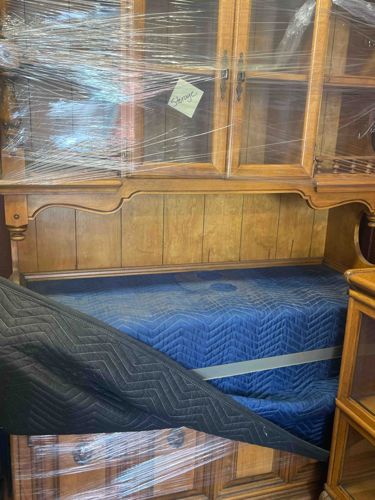
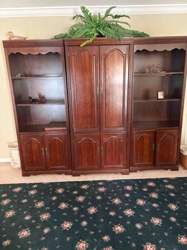
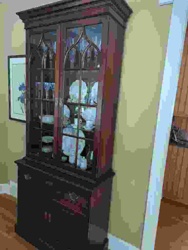
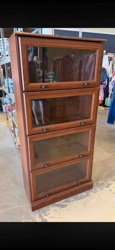
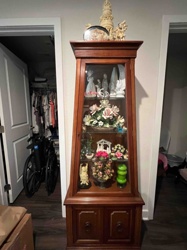
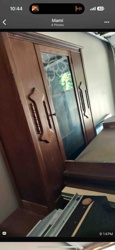
This is a wooden hutch, likely constructed from maple given the provided context, exhibiting a warm, light-to-medium brown finish. The hutch is currently wrapped in clear plastic film, with blue and black quilted moving blankets covering the lower sections. The upper section features a cabinet with glass doors, allowing items placed inside to be displayed. These doors appear to have decorative metal pulls, possibly in a dark, aged finish. Below the upper cabinet, there is an open shelf area with a paneled wood back, suggestive of a traditional or classic design. The trim work on the hutch, particularly around the open shelf area and the base of the upper cabinet, shows decorative curves and shaping, indicating attention to detail in its construction. The visible portion of the lower hutch suggests a drawer or cabinet section with carved or molded details on the drawer fronts or panels. The wood grain is visible throughout, suggesting solid wood or a high-quality veneer. Due to the wrapping, it's difficult to ascertain specific condition issues beyond some dust accumulation on the blue moving blanket. No clear manufacturer's marks or signatures are discernible. The overall style appears to be traditional or colonial revival, likely dating from the mid-20th century, possibly 1950s to 1970s. The craftsmanship appears to be of good quality, with solid construction and decorative elements, making it a functional and aesthetic piece of dining or living room furniture.
AI Appraisal Report
Upon examining the provided image and information regarding this Maple Hutch, I observe a well-crafted piece characteristic of mid-20th century furniture, likely dating from the 1950s to 1970s. The warm, light-to-medium brown finish and visible wood grain suggest solid maple construction or an exceptionally high-quality veneer, as indicated by the owner. The design elements, including the glass-doored upper cabinet, open shelf with a paneled back, decorative trim work, and what appear to be carved or molded details on the lower section, align with traditional or Colonial Revival styles.
Regarding condition, the hutch is currently protected by clear plastic film and moving blankets, making a definitive assessment challenging. However, from the visible areas, the wood appears structurally sound with no immediately discernible damage. The plastic wrap prevents a thorough inspection for scratches, dents, or finish inconsistencies. The presence of dust on the moving blanket is superficial and not a condition concern for the hutch itself.
In terms of market conditions, demand for well-maintained vintage furniture, particularly functional storage and display pieces like hutches, remains consistent. While not a rare item, the apparent quality of construction and classic design contribute to its appeal. Comparables for a hutch of this style and assumed material quality typically fall within the "good" used furniture market. Factors significantly impacting value are primarily its condition (which needs in-person verification), the actual wood type (solid vs. veneer), and any hidden damage not visible through the wrapping.
My assessment of authenticity is limited to visual cues. The style and construction visible are consistent with the period; however, without an in-person examination, I cannot verify the specific wood species (maple versus a similar-looking wood), confirm solid wood construction, or identify any manufacturer's marks that might be obscured. Full authentication would require a hands-on inspection to assess joinery, wood grain patterns in non-visible areas, and any hidden labels or stamps. Scientific testing for wood species or age is not typically necessary for pieces of this era unless provenance is questioned or a higher value is attributed.