AI estimate as of July 10, 2025 · verify with a professional before acting
AI-Generated · Verify before acting
Everything on this page is generated by AI for informational purposes only. AI can make mistakes — the AI may misidentify items or misattribute them (artist, maker, brand, designer, origin, era). This is not an official valuation and should not be used for insurance, sale, tax, estate, legal, or lending purposes — or any decision requiring a certified appraisal. It is not an authoritative claim about any person, brand, or rights holder — do not share or rely on it as a factual statement about a third party. Always consult qualified professionals before making financial decisions.
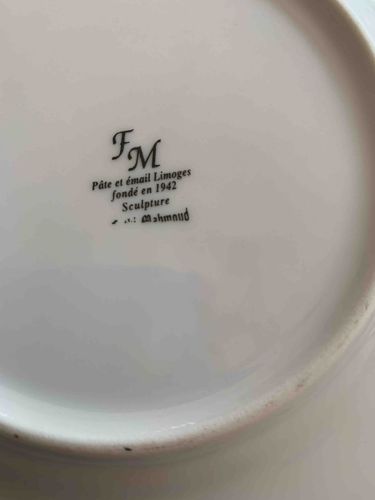
The item appears to be a white ceramic or porcelain dish or plate, likely a saucer or a small plate, based on the curved edge visible in the images. The material is glazed, exhibiting a smooth, reflective surface with a pure white or off-white color. The visible base or underside of the dish is unglazed in some areas, revealing the natural bisque color of the ceramic, which is a common characteristic of such items. The most prominent feature is the backstamp or maker's mark, centrally placed on the underside. This mark includes the stylized black lettering "FM" at the top, a common initial mark, followed by the text "Pâte et émail Limoges fondé en 1942". This specifies that the item is made from 'Pâte et émail' (paste and enamel) and originates from Limoges, France, a renowned center for porcelain manufacturing. The 'fondé en 1942' indicates the founding year of the manufacturer, suggesting an estimated age of mid-20th century or later. Below this, the words "Sculpture" and what appears to be "Mahmoud" are visible, although 'Mahmoud' is partially obscured and difficult to fully decipher. This could indicate the item is part of a sculptural series or designed by Mahmoud. The craftsmanship appears to be of high quality, typical of Limoges production, with a clean and precise application of the glaze. There are a few minor dark specks along the rim/edge of the dish's base, which could be small manufacturing imperfections, dust embedded in the glaze, or minor surface wear/dirt, though they do not appear to be significant damage. The overall condition seems good, suggesting careful handling or display.
AI Appraisal Report
Upon examining the provided images of this Limoges Pâte et émail plate with the 'FM' mark, I assess its condition as good. The glaze appears intact and clean, showing minimal signs of wear beyond some minor dark specks along the unglazed base edge, which are likely manufacturing imperfections or superficial residues rather than significant damage. The prominent backstamp 'FM', 'Pâte et émail Limoges fondé en 1942', and 'Sculpture' with what appears to be 'Mahmoud' strongly suggests authenticity as a product from a Limoges studio established in 1942. The 'Pâte et émail' designation indicates a specific artistic technique. Without physical inspection, I cannot confirm the exact nature of 'pâte et émail' or 'sculpture' in relation to this specific piece, but the mark indicates a higher-end artisan product rather than mass-produced utilitarian ware.
While Limoges porcelain is highly collectible, the value hinges on the specific maker, artist (if 'Mahmoud' refers to one), intricacy of decoration (which is not visible on the top surface here), and rarity. This particular mark indicates a post-1942 establishment, suggesting it's likely a mid-20th century to contemporary piece. Comparables for smaller, unmarked or less artistically significant Limoges saucers or small plates typically range from $15-$50. However, the 'Pâte et émail' and 'Sculpture Mahmoud' (if it indicates an artist) elevate its potential value significantly. The demand for such artisan pieces depends on the artist's recognition and the uniqueness of the design, which I cannot ascertain fully from the base alone. Its rarity is currently moderate, as it's not a common mark, but not as scarce as truly antique or very early Limoges.
Factors impacting value include the 'Pâte et émail' technique, which may imply custom or artistic production, and the potential artist identification. The main limitation in this appraisal is the lack of a view of the plate's decorated surface, which is critical for assessing artistic merit and design complexity. Furthermore, 'Mahmoud' needs to be confirmed as an artist. Without in-person examination, I cannot detect subtle repairs, hairline cracks, or precise glaze imperfections. Full authentication would require expert physical inspection, microscopic analysis of the 'Pâte et émail' technique, and more importantly, provenance documentation linking it to the 'FM' studio and 'Mahmoud' artist, if applicable. Research into the 'FM' Limoges studio founded in 1942 and any associated artists like 'Mahmoud' would be essential for a definitive valuation.