These notes were written by the person who submitted this item. Appraiser.AI has not verified them, and the AI's identification and estimate may rely on them.
AI Estimated Value
Not an official valuation
$40-70
AI estimate as of November 16, 2025 · verify with a professional before acting
AI-Generated · Verify before acting
Everything on this page is generated by AI for informational purposes only. AI can make mistakes — the AI may misidentify items or misattribute them (artist, maker, brand, designer, origin, era). This is not an official valuation and should not be used for insurance, sale, tax, estate, legal, or lending purposes — or any decision requiring a certified appraisal. It is not an authoritative claim about any person, brand, or rights holder — do not share or rely on it as a factual statement about a third party. Always consult qualified professionals before making financial decisions.
This analysis also relies on unverified notes provided by the user, which may be incomplete or inaccurate and could affect the result.
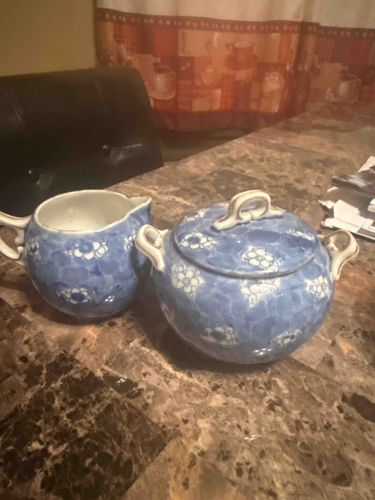
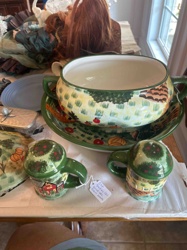
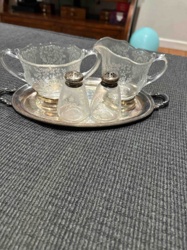
This is a two-piece ceramic set consisting of a sugar bowl with a lid and a creamer. Both pieces feature a distinctive blue and white floral pattern, likely hand-painted or a transferware design. The base color is a muted, somewhat mottled or crackled blue, giving the impression of age or a specific design aesthetic. Overlaid on this blue background are numerous small, white floral motifs, possibly representing cherry blossoms or a similar delicate flower, scattered across the entire surface of both vessels and the sugar bowl's lid. The sugar bowl is rounded with two small, arched handles on either side, finished in white. Its lid also has a matching white, loop-shaped finial for easy lifting. The creamer has a classic pitcher form with a spout and a single curved handle, also finished in white, extending from the rim to the body. The interior of the creamer appears to be a plain off-white or cream color. No visible manufacturing marks or signatures are discernable from the provided image. The style suggests a possible Asian influence, perhaps Japanese or Chinese, and could date from the mid-20th century or earlier, making them potentially vintage. The overall condition appears good, with no obvious chips, cracks, or significant wear visible, though a closer inspection would be needed to confirm this. The craftsmanship appears to be of standard quality for decorative ceramic tableware, with consistent application of the pattern.
AI Appraisal Report
Upon visual examination of the provided image, this Blue and White Floral Pattern Ceramic Sugar Bowl and Creamer Set appears to be in good overall condition. I observe no obvious chips, cracks, or significant wear, though a definitive assessment of condition, especially for hairline cracks or crazing, would require a direct, in-person inspection. The design, featuring a muted blue background with white floral motifs and white handles/finials, suggests a possible Asian influence, perhaps transferware given the consistency of pattern. The base color appearing 'mottled or crackled' might be intentional aging or a design aesthetic, rather than actual damage, but this too would benefit from a tactile review.
From a market perspective, comparable vintage blue and white ceramic sugar and creamer sets, especially those without established manufacturer marks or provenance, typically fall into the lower-to-mid range of decorative tableware. Sets with identifiable Asian art pottery origins from respected studios or specific historical periods could command higher prices, but without such identification, they are primarily valued for their aesthetic appeal and functional condition. Demand for such sets tends to be steady but not exceptionally high, positioning them as attractive decorative or functional pieces rather than high-value collector's items.
Key factors impacting value include the lack of visible maker's marks, which significantly hinders attribution and therefore market confidence. The 'vintage' aesthetic is appealing, but without specific dating or manufacturing details, it remains speculative. The craftsmanship appears standard for decorative ceramic tableware, which supports its functional and aesthetic value. For full authentication and to ascertain true age, origin, and detailed condition, an in-person examination is crucial. This would allow for examination of the base for marks, assessment of the glaze quality, verification of any crazing, and determination if the 'mottled' blue is intentional or superficial. Without this, authenticity of origin beyond general style is limited to visual interpretation.