AI estimate as of August 16, 2025 · verify with a professional before acting
AI-Generated · Verify before acting
Everything on this page is generated by AI for informational purposes only. AI can make mistakes — the AI may misidentify items or misattribute them (artist, maker, brand, designer, origin, era). This is not an official valuation and should not be used for insurance, sale, tax, estate, legal, or lending purposes — or any decision requiring a certified appraisal. It is not an authoritative claim about any person, brand, or rights holder — do not share or rely on it as a factual statement about a third party. Always consult qualified professionals before making financial decisions.
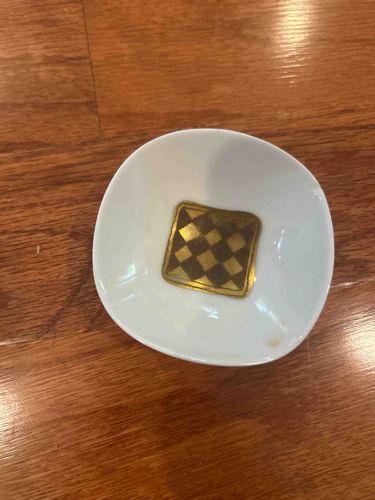
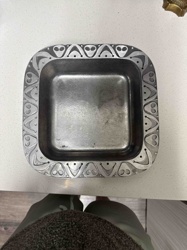
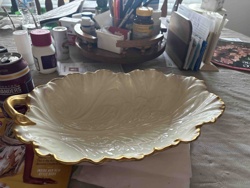
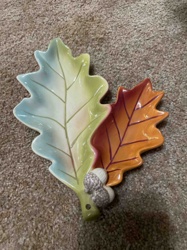
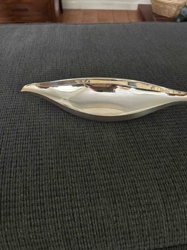
This item is a small, shallow decorative dish or trinket tray, likely made of ceramic or porcelain given its smooth, glossy white finish. It has an irregular, somewhat organic or square-with-rounded-corners shape rather than a perfectly circular or rectangular form. The dish features a central square design with a gold and black checkered pattern. The gold portions appear metallic and reflective, suggesting a metallic overlay or luster glaze, while the black squares are matte or less reflective, creating a strong contrast. A raised border defines the central checkered motif, indicating a deliberate design element. The overall color scheme is stark white with the prominent gold and black accent.
In terms of condition, there are some visible signs of wear and surface discoloration, particularly a light brownish-yellow stain visible on the white portion of the dish near the bottom right of the central design. This suggests either accumulated dirt, a residue from an item previously held in the dish, or a superficial blemish. There are no immediately apparent chips, cracks, or significant abrasions from the single provided image, although the view is limited to the interior of the dish. The craftsmanship appears to be of good quality, with a clean application of the checkered pattern, suggesting it was either hand-decorated with precision or machine-printed with a high degree of fidelity. The age and precise manufacturing details are not discernible without maker's marks or further context, but its style suggests it could be mid-20th century to contemporary.
AI Appraisal Report
Upon examining the provided image of the small white ceramic/porcelain dish with a gold and black checkered design, I would assess its condition as fair to good used condition. There is clear evidence of surface discoloration or a stain on the white surface near the bottom right of the central design, which significantly impacts its aesthetic appeal and thus its value. While no chips or cracks are apparent from this single view, a physical inspection would be crucial to confirm structural integrity and detect any hairline fractures or other hidden flaws. The craftsmanship of the checkered pattern appears good, suggesting it was well-executed, either by hand with precision or a quality machine process.
Authenticity cannot be definitively verified from an image alone. Without maker's marks, provenance documentation, or an in-person examination to assess the material quality, weight, and subtle manufacturing details, it's impossible to attribute it to a specific maker or period with certainty. An in-person inspection would allow for examination of the base for marks, assessment of the gold application's quality (e.g., whether it's genuine gold luster), and tactile evaluation of the ceramic body.
In terms of market conditions, decorative trinket dishes of this nature are abundant. While the gold and black checkered motif is striking, the general market for such items is not typically high-value unless associated with a renowned designer, manufacturer, or significant historical provenance. Comparables would include mass-produced decorative ceramics from the mid-20th century onwards. The demand for generic decorative dishes is moderate, and rarity is low unless it's a unique artisan piece or from a highly collectible series.
The primary factors impacting value are the current visible stain, the lack of definitive maker identification, and the commonality of similar decorative items. If the stain were removable, and if the piece were authenticated as a designer piece (e.g., from a well-known ceramicist or luxury brand), its value could increase substantially. Without such a discovery, it remains a common decorative object. Limitations in authenticity verification from images alone are profound; a tactile sense of the material, microscopic examination of the glazes, and potential identification of manufacturing clues (e.g., kiln marks, specific production techniques) are all absent.
To fully authenticate and maximize value, an in-person examination, professional cleaning to address the stain, and research into potential maker's marks or design archives would be necessary. Scientific testing of the gold content could also be pursued if there were strong indications of high-value materials.