AI estimate as of November 9, 2025 · verify with a professional before acting
AI-Generated · Verify before acting
Everything on this page is generated by AI for informational purposes only. AI can make mistakes — the AI may misidentify items or misattribute them (artist, maker, brand, designer, origin, era). This is not an official valuation and should not be used for insurance, sale, tax, estate, legal, or lending purposes — or any decision requiring a certified appraisal. It is not an authoritative claim about any person, brand, or rights holder — do not share or rely on it as a factual statement about a third party. Always consult qualified professionals before making financial decisions.
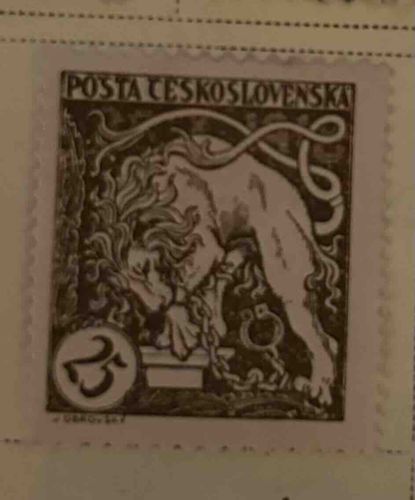
This item is a vintage postage stamp from Czechoslovakia, specifically from the 1920 'Hradcany Surcharge Issue.' The stamp features a monochrome design, likely in a dark brown or sepia tone against a lighter background, possibly cream or light grey paper, indicative of its age and printing process. The central motif is a stylized, heraldic lion, depicted dynamically with an ornately flowing mane and tail that twists into decorative flourishes. The lion appears to be breaking free from or interacting with a heavy chain, which is visible wrapped around its body and extending towards the foreground. Below the lion, on the left side, is a prominent circular or oval cartouche containing the denomination '25' followed by what appears to be a smaller 'h' for 'haleru' (heller), indicating a surcharged value. The top border of the stamp clearly displays the text 'POSTA CESKOSLOVENSKA' in capital letters, signifying its origin. At the bottom left, the faint inscription 'J. OBROVSKY' is visible, identifying the artist or engraver. The stamp exhibits classic perforation around its edges, although the specific count is not discernible from the image. The overall condition appears to be relatively good for its age, though minor wear or slight discoloration consistent with handling and storage within an album is possible, given its presentation. The intricate details of the lion, the elegant script, and the art nouveau-like elements in the design point to a high level of craftsmanship. The reverse side is not visible, so gum condition or watermarks cannot be assessed. This stamp represents a historical period following the establishment of Czechoslovakia as an independent state, and such issues often hold cultural and historical significance beyond their postal utility.
AI Appraisal Report
I have examined the image of the Czechoslovakia 1920 Hradcany Surcharge Issue Postage Stamp, 25h on 50h, Lion and Chain Design. Based on visual assessment, the stamp appears to be in very good condition for its age, exhibiting clear details of the "Lion and Chain" motif by J. Obrovsky. The monochrome brown/sepia tone is consistent with this issue, and the perforations appear intact, though their exact count cannot be verified. The design details, including the "POSTA CESKOSLOVENSKA" inscription and the "25h" surcharge, seem accurate, suggesting authenticity.
Market comparables for this particular Hradcany Surcharge issue, especially those in well-preserved condition, indicate a steady demand among collectors of Czechoslovakian philately. While not extraordinarily rare, stamps with good centering and clear impressions fetch higher prices. The historical significance of this post-WWI independence issue adds to its appeal. Factors impacting value positively include its apparent good condition and clear surcharge. Negative impacts would arise from hidden faults like thinning, repairs, or re-gumming.
It is crucial to acknowledge the limitations of appraising solely from an image. I cannot definitively verify authenticity, gum condition, watermarks, paper types, or detect any subtle repairs, thins, or hidden faults that would significantly alter its value. A physical, in-person examination by a philatelic expert, coupled with a review of any available provenance documentation, and potentially UV light testing, would be required to fully authenticate the stamp and provide a precise valuation.