AI Appraisal Estimate

AI-generated estimates · not official valuations

From the user

What was submitted

Photo and notes provided by the user — not generated by AI

Submitted item photo
Submitted photo · June 18, 2026

User's notes

No additional notes provided.

AI analysis below

AI appraisal

AI analysis & estimate

AI-Generated · Verify before acting

Everything below is generated by AI for informational purposes only. AI can make mistakes — the AI may misidentify items or misattribute them (artist, maker, brand, designer, origin, era). This is not an official valuation and should not be used for insurance, sale, tax, estate, legal, or lending purposes — or any decision requiring a certified appraisal. It is not an authoritative claim about any person, brand, or rights holder — do not share or rely on it as a factual statement about a third party. Always consult qualified professionals before making financial decisions.

Read the full disclaimer

AI Identification

·Not independently authenticated·Verify before acting

Antique Carved Wooden Incense Burner or Censer

Home Decor & Religious Artifacts

AI Estimated Value

·Not an official valuation·Verify before acting

$450 - $650

As of June 18, 2026

AI Item Analysis

·AI can make mistakes·Verify before acting
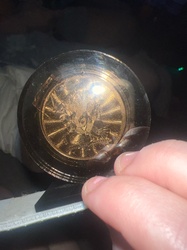
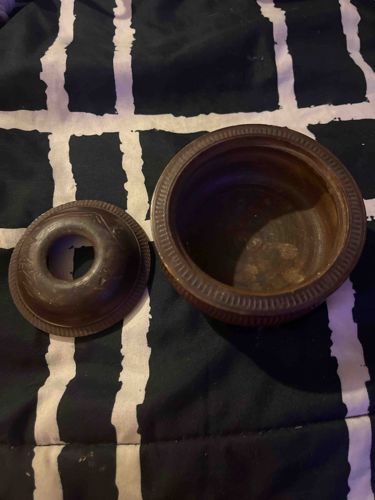
This item is a two-piece hand-carved wooden vessel, likely utilized as an incense burner or censer. The object consists of a deep circular base and a matching domed lid featuring a central aperture for smoke ventilation. Both components are crafted from a dark, dense wood, possibly mahogany or a similar tropical hardwood, showing a deep espresso-brown patina. The exterior design features a distinctive fluted or 'gadrooned' texture around the rim of the base and the outer edge of the lid, indicating a high level of manual craftsmanship. The lid is further adorned with shallow-relief floral or scrollwork carvings surrounding the central hole. Looking into the bowl, there appears to be significant charring, soot accumulation, and surface oxidation, consistent with prolonged use for burning resins or coals. The condition shows age-appropriate wear, including minor scuffs on the textured edges and a dulling of the original finish. No visible maker's marks or signatures are present, suggesting an artisanal or folk-art origin. Based on the construction style and wear patterns, the piece likely dates from the late 19th to early 20th century.

AI Appraisal Report

·AI can make mistakes·Verify before acting
I have conducted a visual examination of this two-piece carved wooden censer, likely dating to the late 19th or early 20th century. The piece exhibits characteristics of high-quality manual craftsmanship, specifically the gadrooned rim and shallow-relief floral carvings on the lid. The dense wood and espresso-colored patina suggest a tropical hardwood, which has aged gracefully. The presence of significant carbonization and internal charring confirms its functional history as a religious or domestic incense burner, adding to its authenticity as a utilitarian artifact rather than a modern decorative reproduction. The condition is consistent with age; minor scuffs on the high points of the fluting and the dulling of the finish are expected for an organic object of this vintage. In the current market, there is a steady demand for late Victorian and Edwardian-era wooden religious objects, particularly those with a folk-art or artisanal quality. Similar carved hardwood vessels typically fetch between $400 and $700 at regional auctions, depending on wood species and historical provenance. However, a definitive valuation is limited by the digital nature of this inspection. Authenticating the specific wood species and ruling out modern stains or 'distressing' techniques requires an in-person examination. To confirm the top-end value, I would need to perform a wood-grain macro-analysis and check for the presence of modern adhesive or circular saw marks hidden within the joinery. Provenance documentation regarding its geographic origin—whether Southeast Asian, Colonial Indian, or European—would significantly influence rarity and final market positioning. Scientific testing of the residue could also be used to identify types of resins burned, potentially linking it to specific cultural traditions.

Get your items appraised

Instant estimates of your treasures with AI-powered appraisals

Browse More Appraisals