Vintage Brass and Ebony Inlay Crucifix
Religious Artifacts

Vintage Brass and Ebony Inlay Crucifix

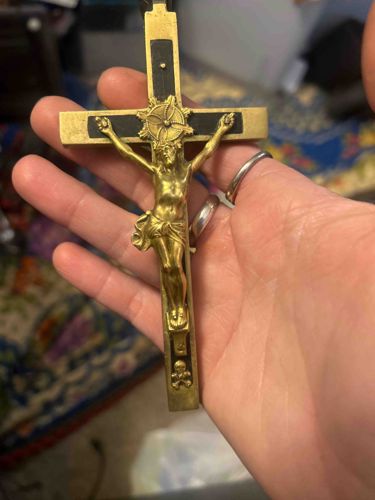
This item is a traditional handheld or wall-mounted crucifix, approximately 4 to 5 inches in height. It is constructed from a heavy brass or gilded metal frame with dark wood inlays, likely ebony or stained fruitwood, positioned within the recessed channels of the cross. The figure of Christ (the corpus) is cast in the same brass tone, showing detailed muscularity and a draped loincloth. A notable feature is the halo behind the head of Christ which resembles a ship's wheel or a radiant sunburst. At the base of the cross, there is a distinct skull and crossbones (memento mori) emblem, which is a traditional iconographic element representing Adam's grace and the victory over death. The metal exhibits a significant aged patina with darkening in the recessed areas and slight wear on the high points from handling. The construction suggests a late 19th or early 20th-century origin, likely of European manufacture, given the style of the casting and choice of materials. The craftsmanship is of high quality, with the wood inlays being precisely fitted and the casting of the corpus showing fine anatomical detail for its scale. There are no visible maker's marks on the front, though some typical oxidation is present on the metallic surfaces.
Estimated Value

$175 - $250

Basic Information

Category

Religious Artifacts

Appraised On

January 9, 2026

Estimated Value

$175 - $250

Item Description

This item is a traditional handheld or wall-mounted crucifix, approximately 4 to 5 inches in height. It is constructed from a heavy brass or gilded metal frame with dark wood inlays, likely ebony or stained fruitwood, positioned within the recessed channels of the cross. The figure of Christ (the corpus) is cast in the same brass tone, showing detailed muscularity and a draped loincloth. A notable feature is the halo behind the head of Christ which resembles a ship's wheel or a radiant sunburst. At the base of the cross, there is a distinct skull and crossbones (memento mori) emblem, which is a traditional iconographic element representing Adam's grace and the victory over death. The metal exhibits a significant aged patina with darkening in the recessed areas and slight wear on the high points from handling. The construction suggests a late 19th or early 20th-century origin, likely of European manufacture, given the style of the casting and choice of materials. The craftsmanship is of high quality, with the wood inlays being precisely fitted and the casting of the corpus showing fine anatomical detail for its scale. There are no visible maker's marks on the front, though some typical oxidation is present on the metallic surfaces.
Get Your Items Appraised

Instant estimates of your treasures with AI-powered instant appraisals

Browse More Appraisals