AI estimate as of September 12, 2025 · verify with a professional before acting
AI-Generated · Verify before acting
Everything on this page is generated by AI for informational purposes only. AI can make mistakes — the AI may misidentify items or misattribute them (artist, maker, brand, designer, origin, era). This is not an official valuation and should not be used for insurance, sale, tax, estate, legal, or lending purposes — or any decision requiring a certified appraisal. It is not an authoritative claim about any person, brand, or rights holder — do not share or rely on it as a factual statement about a third party. Always consult qualified professionals before making financial decisions.
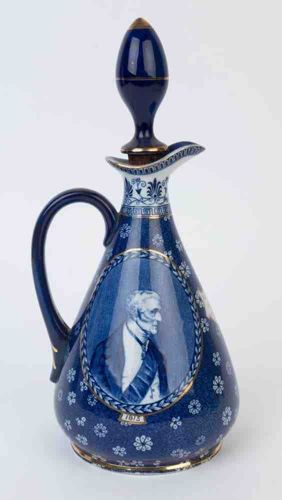
This is a decorative porcelain decanter, likely intended for spirits or wine, featuring a distinctive obelisk-shaped stopper. The decanter has a bellied, tapered body with an integrated handle, all crafted from white porcelain and heavily decorated with a rich cobalt blue glaze and intricate gold accents. Its dominant feature is a large, oval-framed portrait of a distinguished gentleman, highly suggestive of Admiral Horatio Nelson, rendered in blue and white on the front, with '1813' inscribed below, indicating either a commemorative date or a production date. The overall blue pattern includes vertical stripes, small floral motifs resembling forget-me-nots, and ornate rococo-style scrollwork around the neck and spout. The stopper itself is deep blue with a gold finial and band. Gold rimming highlights the base, handle, spout, and stopper. The item appears to be in excellent condition with no visible chips, cracks, or significant wear to the glaze or gold detailing, suggesting it has been well-preserved. The craftsmanship indicates a high-quality decorative piece, possibly from a European porcelain manufacturer known for commemorative wares. The style period is likely late 19th to early 20th century, given the commemorative nature and classical portraiture, albeit with an 1813 date which could refer to a historical event it is commemorating. The strong artistic detail and vibrant colors contribute to its aesthetic appeal and uniqueness.
AI Appraisal Report
This porcelain decanter, commemorating Lord Nelson, appears to be in excellent condition, with no visible chips, cracks, or significant wear to the vibrant cobalt blue glaze or extensive gold detailing. The portrait of Nelson and the '1813' date are well-preserved, suggesting careful handling throughout its history. Based on visual cues, the craftsmanship indicates an authentic decorative piece of its era, likely late 19th to early 20th century European manufacture, given the style and typical commemorative subject matter. The high level of artistic detail and good state of preservation contribute significantly to its aesthetic appeal and value.
From the image alone, I can assess condition and apparent quality. However, a definitive authenticity verification regarding its exact manufacturer and original production year would require an in-person examination to check for maker's marks or factory stamps, which are not visible in the provided image. Provenance documentation, such as original sales receipts or family histories, would further confirm its authenticity and historical context. Scientific testing, such as elemental analysis of the porcelain or glazes, is generally not pursued for items in this price range unless there's a specific dispute regarding age or origin.
The market for commemorative porcelain, especially pieces related to significant historical figures like Lord Nelson, remains steady among collectors of decorative arts and militaria. While not exceedingly rare, high-quality, well-preserved examples like this one are sought after. Comparables include other finely decorated commemorative decanters or historical portraiture on porcelain from known European manufacturers such as Royal Doulton or Wedgwood, though this piece's specific manufacturer is unconfirmed without physical inspection. The '1813' inscription likely refers to a historical event or a significant anniversary, rather than the true production date. Demand is consistent for pieces with strong visual appeal and good condition. The main value drivers are its excellent preservation, detailed artistry, and the historical significance of the subject.
While this appears to be a genuine period piece, the absence of visible maker's marks and definitive provenance information prevents a higher valuation. My appraisal range reflects the strong condition and aesthetic merit, balanced with the limitations of visual-only assessment.