AI identification & appraisal estimate

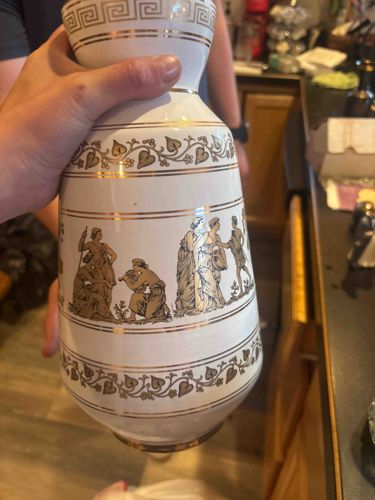
Greek Revival Ceramic Vase/Decanter with Mythological Figures

Submitted photo of Greek Revival Ceramic Vase/Decanter with Mythological Figures
Photo submitted by the user — not generated by AI

User's notes

Greece 24k

These notes were written by the person who submitted this item. Appraiser.AI has not verified them, and the AI's identification and estimate may rely on them.

AI Estimated Value

Not an official valuation

$250-

AI estimate as of July 23, 2025 · verify with a professional before acting

AI-Generated · Verify before acting

Everything on this page is generated by AI for informational purposes only. AI can make mistakes — the AI may misidentify items or misattribute them (artist, maker, brand, designer, origin, era). This is not an official valuation and should not be used for insurance, sale, tax, estate, legal, or lending purposes — or any decision requiring a certified appraisal. It is not an authoritative claim about any person, brand, or rights holder — do not share or rely on it as a factual statement about a third party. Always consult qualified professionals before making financial decisions.

This analysis also relies on unverified notes provided by the user, which may be incomplete or inaccurate and could affect the result.

Read the full disclaimer

AI Item Analysis

This item is a decorative vase or decanter, characterized by its white ceramic or porcelain body adorned with extensive gold-colored decoration. The overall form is ovoid, featuring a distinct narrow neck that widens slightly at the rim and a rounded base. The primary decorative motif on the main body of the vessel consists of a continuous band depicting classical Greek-style figures in various poses, rendered in a brownish-gold or sepia-toned hue, implying a relief or transfer print technique. This central frieze is bordered by thin gold lines above and below. Further ornate decoration includes bands of intricate gold patterns: a repeating volute or meander (Greek key) pattern around the narrow part of the neck, and a more organic, leafy vine motif with small floral clusters encircling the top and bottom sections of the main body. The gold decoration, described as '24k' in the context, suggests the use of genuine gold leaf or a high-quality gold wash, although visual inspection alone cannot confirm the karatage. There are no readily visible chips, cracks, or significant wear on the surface, indicating good preservation. The gold detailing appears largely intact, with perhaps minor areas of rubbing consistent with handling or age, but no major loss is apparent. There are no discernible maker's marks or signatures visible from the provided image, which would typically be found on the base. The style strongly evokes ancient Greek pottery, specifically amphorae or kraters, suggesting it is a modern decorative piece inspired by classical antiquity, likely manufactured in Greece. The quality of the applied decoration, particularly the detail in the figural scenes and the crispness of the geometric patterns, suggests a moderately to well-executed piece of ceramic artistry.
AI Appraisal Report

Upon my virtual examination of this Greek Revival Ceramic Vase/Decanter, I assess its condition as excellent, showing no obvious chips, cracks, or significant wear. The gold detailing, reportedly '24k' though unverified visually, appears largely intact with only minor rubbing consistent with age. Its authenticity as a decorative piece inspired by classical antiquity, likely manufactured in Greece, seems plausible given the stylistic elements. However, without a maker's mark, physical inspection is crucial to confirm origin and true age. In my assessment, I've considered market conditions for similar decorative items. Pieces of this quality, especially those with intricate gold work and detailed mythological scenes, generally appeal to collectors of neoclassical decor. While decorative, this item lacks the historical provenance or the confirmed antiquity that would command higher values. The '24k' gold claim, if verifiable, would add to its intrinsic value, but without in-person assessment, it remains a self-reported attribute. Demand for such items is steady among collectors of classical-inspired art, though rarity is not exceptionally high unless a known artisan or manufacturer is identified through a physical mark. The most significant factor impacting its value is the lack of a discernible maker's mark and the inability to physically verify the '24k' gold application. For a full authentication, I would require a direct physical examination to inspect the base for marks, assess the ceramic quality firsthand, and potentially perform scientific testing on the gold content if warrented. Provenance documentation would also significantly enhance its value.

Keep exploring

More decorative arts appraisals

Get your items appraised

Instant AI-powered appraisal estimates from a photo

Browse More Appraisals