AI estimate as of July 24, 2025 · verify with a professional before acting
AI-Generated · Verify before acting
Everything on this page is generated by AI for informational purposes only. AI can make mistakes — the AI may misidentify items or misattribute them (artist, maker, brand, designer, origin, era). This is not an official valuation and should not be used for insurance, sale, tax, estate, legal, or lending purposes — or any decision requiring a certified appraisal. It is not an authoritative claim about any person, brand, or rights holder — do not share or rely on it as a factual statement about a third party. Always consult qualified professionals before making financial decisions.
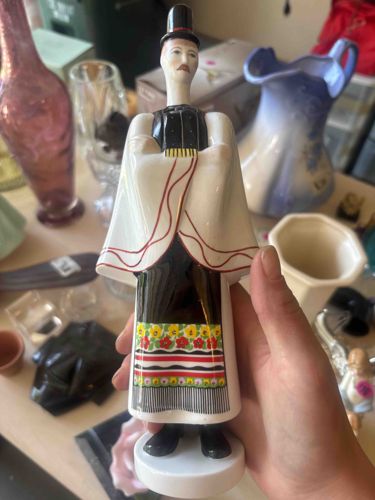
This appears to be a ceramic or porcelain decanter, likely intended for liquor or spirits, stylized in the form of a male figure dressed in traditional folk attire. The figure stands on a circular white base, with black feet or shoes visible. He wears a black top hat, a black jacket or vest with yellow horizontal stripes at the bottom, and a long black skirt or dress-like garment. Over the black attire, he is draped in a white cape or shawl, which features elegant red lines that curve and meander across its surface, adding a dynamic visual element. The most striking feature of the lower body is a vibrant patterned apron or sash. This apron showcases rows of colorful floral motifs (yellow and red flowers with green leaves), red and white horizontal stripes, and a band of black and white vertical lines resembling fringe or pleats. The figure's face is characterized by a prominent, elongated nose, a painted light brown mustache, and a stern or neutral expression. The skin tone is a pale, off-white. There are no immediately visible manufacturer marks, signatures, or stamps from the image provided, which limits identification of the maker or precise origin. The overall style, particularly the folk costume and the somewhat stylized, almost caricature-like facial features, suggests a mid-20th century European origin, possibly from a region known for folk art or traditional ceramics. The item appears to be in good condition with no obvious chips, cracks, or significant wear visible, though specific condition can only be fully assessed with a hands-on inspection. The craftsmanship indicates a factory production, likely mass-produced but with attention to decorative detail, particularly in the hand-painted elements of the costume. It functions as a decorative object that also serves a practical purpose as a container, likely for the barware segment of domestic furnishings.
AI Appraisal Report
Upon examining the images of this Folk Art Gentleman Figural Decanter, I assess it to be a mid-20th century European ceramic, likely of Italian or Eastern European origin. The piece is in what appears to be very good vintage condition, with vibrant hand-painted details and no visible chips, cracks, or crazing. The folk costume, with its patterned apron and distinct hat, is typical of decorative barware produced for the export or tourist market during that era. While the craftsmanship suggests factory production rather than a unique studio piece, the decorative quality is high.
The market for such figural decanters is generally stable. Similar unmarked, mass-produced ceramic decanters from the mid-century period typically sell in the secondary market. Current market conditions see comparable items, often sold as 'Italian Pottery' or 'Folk Art,' achieving modest prices. Demand is driven by collectors of figural ceramics, decanters, and folk art. The primary factor limiting the value is its likely mass-produced, unmarked nature. A signature from a known manufacturer like Robj (Paris) or a renowned Italian studio would increase its value exponentially, but no such mark is visible.
Without a physical examination, I cannot confirm the material composition, check for hidden repairs under blacklight, or search for faint impressed marks. Full authentication would require in-person inspection to identify any maker's marks on the underside and to assess the true condition of the glaze and stopper. Provenance documentation would also significantly aid in confirming its origin and history.