AI estimate as of October 2, 2025 · verify with a professional before acting
AI-Generated · Verify before acting
Everything on this page is generated by AI for informational purposes only. AI can make mistakes — the AI may misidentify items or misattribute them (artist, maker, brand, designer, origin, era). This is not an official valuation and should not be used for insurance, sale, tax, estate, legal, or lending purposes — or any decision requiring a certified appraisal. It is not an authoritative claim about any person, brand, or rights holder — do not share or rely on it as a factual statement about a third party. Always consult qualified professionals before making financial decisions.
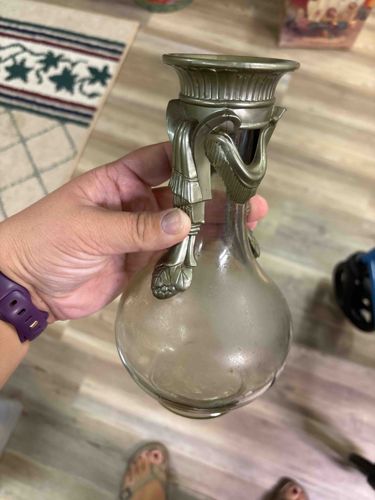
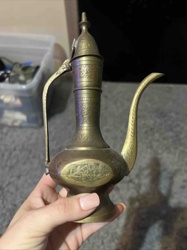
This item is a decanter or small vase that features a clear glass body adorned with an intricate, antiqued silver-tone metal overlay. The overall height appears to be approximately 8-10 inches, considering it is being held comfortably in an adult hand. The glass body has a rounded, bulbous base tapering upwards to a narrower neck, which is almost entirely enveloped by the metalwork. The metal overlay is the most striking feature, cast in an Art Nouveau or possibly Neoclassical Revival style. It forms a decorative collar around the neck, flaring out at the rim with vertical fluted or reeded patterns. Below this, there are two prominent handle-like structures that resemble stylized swan or bird heads with elongated necks curving down towards the mid-body of the glass. These handles are highly decorative, featuring intricate feather detailing and ending in a floral or leaf motif where they attach to the glass. The metal shows a distressed or antiqued finish, suggesting either intentional aging or natural patina build-up, giving it a somewhat dull luster rather than a bright, polished shine. The glass itself appears to be hand-blown or molded, with some subtle irregularities and a slightly smoky or cloudy appearance, possibly from age, oxidation, or residue from previous contents. There are no visible chips or cracks in the glass, and the metal overlay seems to be securely attached, though some minor wear or rubbing on the metal is discernible upon close inspection. The craftsmanship indicates a decorative, possibly ornamental piece intended for display or occasional use rather than heavy utility. The style suggests an early to mid-20th century origin, possibly from the 1920s to 1950s, drawing heavily from historical design elements.
AI Appraisal Report
I have examined the provided image of this Art Nouveau Style Decanter with Metal Overlay. The item presents as a clear glass decanter or vase approximately 8-10 inches tall with an elaborate, antiqued silver-tone metal overlay. The design, particularly the stylized swan or bird-head handles and the fluted rim, strongly evoke the Art Nouveau aesthetic, potentially transitioning into Neoclassical Revival influence, dating its likely origin to the early to mid-20th century (1920s-1950s).
Visually, the condition appears good for its age. I note no visible chips or cracks in the glass, and the metal overlay seems securely attached. The 'distressed' or 'antiqued' finish on the metal suggests either intentional aging or an authentic patina, contributing to its vintage appeal. The slight smoky or cloudy appearance of the glass, if not residue, could indicate age-related oxidation or inherent characteristics of hand-blown glass from that era. Minor wear or rubbing on the metal is expected and consistent with age and use.
Market conditions for Art Nouveau style decorative arts remain steady, particularly for well-executed pieces. While true period Art Nouveau pieces command higher values, items from the subsequent revival periods still attract collectors. Comparables would include similar metal overlay glassware from manufacturers like Loetz, Moser, or unmarked pieces from quality European or American ateliers. The intricate metalwork suggests a higher-end decorative item rather than mass production.
Demand for decorative decanters and vases of this style is moderate. Rarity is difficult to assess without maker's marks or provenance, but the craftsmanship suggests it's not a common 'dime-store' item. Factors impacting value positively include the intricate design, apparent good condition, and aesthetic appeal. The lack of a definitive maker's mark or artist attribution, as well as the 'cloudiness' of the glass if it is permanent, are limiting factors.
It is crucial to state that my assessment of authenticity and condition is limited by examining images alone. For full authentication and a definitive appraisal, an in-person examination is essential. This would allow for a tactile assessment of the metal (e.g., sterling, silver-plated, pewter), closer inspection of the glass for any hidden flaws or repairs, identification of maker's marks, and potential scientific testing of materials. Provenance documentation would also significantly enhance valuation.