These notes were written by the person who submitted this item. Appraiser.AI has not verified them, and the AI's identification and estimate may rely on them.
AI Estimated Value
Not an official valuation
$5 - $10
AI estimate as of November 10, 2025 · verify with a professional before acting
AI-Generated · Verify before acting
Everything on this page is generated by AI for informational purposes only. AI can make mistakes — the AI may misidentify items or misattribute them (artist, maker, brand, designer, origin, era). This is not an official valuation and should not be used for insurance, sale, tax, estate, legal, or lending purposes — or any decision requiring a certified appraisal. It is not an authoritative claim about any person, brand, or rights holder — do not share or rely on it as a factual statement about a third party. Always consult qualified professionals before making financial decisions.
This analysis also relies on unverified notes provided by the user, which may be incomplete or inaccurate and could affect the result.
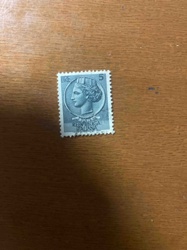
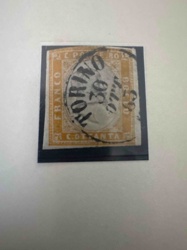
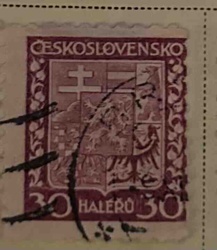
This item is a Hungarian 4 Filler postage stamp, featuring the prominent image of the Holy Crown of Hungary (Szent Korona). The stamp exhibits a deep purplish-brown or plum coloration, printed on what appears to be off-white or yellowish paper. The overall design is intricate, characterized by an ornate rectangular frame with decorative elements along its borders. At the top, the text "MAGYARORSZAG" is visible, identifying the issuing country as Hungary. Below this, the central motif is the Holy Crown, depicted with considerable detail, including its distinctive shape, cross on top, and ornamental jewels (though not individually colored). The crown is set against a background of radiating lines, suggesting a halo or importance. At the bottom of the stamp, the denomination "4 FILLER 4" is clearly displayed, with the number '4' appearing on both the left and right sides, flanking the word "FILLER." The stamp shows signs of having been used, indicated by the partial cancellation mark, which is black and appears to be a postmark, obscuring parts of the upper left and central areas of the crown design. The perforations around the edges are visible, suggesting it was part of a larger sheet. The condition appears to be fair to good for a used stamp of potentially considerable age, with some minor discoloration or foxing visible on the surrounding paper. The detailed engraving work points to a level of craftsmanship common in late 19th or early 20th-century philately. The style is classic for its era, focusing on national symbols. Without a clear date, it's difficult to pinpoint the exact issue year, but such designs were popular in the Austro-Hungarian Empire or early independent Hungary.
AI Appraisal Report
Upon visual examination of the provided image of the Hungarian 4 Filler postage stamp, I assess its authenticity as likely genuine for a common issue of its era, typically late 19th to early 20th century. The design, including the detailed Holy Crown of Hungary and the "MAGYARORSZAG" inscription, aligns with known Hungarian philatelic issues. The deep purplish-brown coloration and "4 FILLER 4" denomination are consistent with standard varieties. However, definitive authentication without physical examination for watermarks, paper type, and printing method is limited.
The condition of this used stamp is fair to good. It exhibits a partial cancellation mark, which, while indicating usage, can sometimes detract from value compared to an uncancelled specimen. The perforations appear intact, but some discoloration or foxing is visible, suggesting age and storage conditions that were not always optimal. This level of wear is typical for stamps of this vintage.
Market conditions for common, used Hungarian stamps from this period are generally stable but not highly lucrative. There is a consistent demand from general collectors of Hungarian philately or those focusing on crown motifs, but the supply of these particular stamps is not scarce. Comparables indicate that used examples of this 4 Filler Holy Crown issue, especially in fair to good condition with a postmark, typically retail in the low single to double-digit dollar range.
Factors impacting this specific stamp's value include its used condition and the visible discoloration. A sharper impression, full cancellation without heavy obscuring of the central design, or being an unmounted mint example would significantly increase its worth. Special varieties such as plate flaws, paper variations, or rare cancellations are not discernible from the image and would require in-person inspection.
Limitations to this appraisal are inherent to image-based examination. I cannot verify the exact paper type, gum condition (if applicable), or watermarks, which are crucial for precise identification of specific printings or varieties. Full authentication would necessitate a physical inspection, ideally under magnification, and potentially comparison with known genuine examples or forensic analysis of the paper and ink if there were any doubts regarding its origin.