AI Appraisal Estimate

AI-generated estimates · not official valuations

From the user

What was submitted

Photo and notes provided by the user — not generated by AI

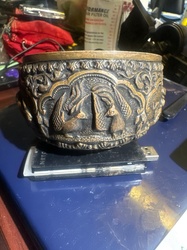
Submitted item photo
Submitted photo · June 28, 2026

User's notes

No additional notes provided.

AI analysis below

AI appraisal

AI analysis & estimate

AI-Generated · Verify before acting

Everything below is generated by AI for informational purposes only. AI can make mistakes — the AI may misidentify items or misattribute them (artist, maker, brand, designer, origin, era). This is not an official valuation and should not be used for insurance, sale, tax, estate, legal, or lending purposes — or any decision requiring a certified appraisal. It is not an authoritative claim about any person, brand, or rights holder — do not share or rely on it as a factual statement about a third party. Always consult qualified professionals before making financial decisions.

Read the full disclaimer

AI Identification

·Not independently authenticated·Verify before acting

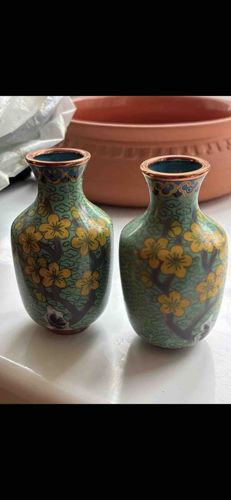
Pair of Miniature Chinese Cloisonné Plum Blossom Vases

Asian Decorative Arts / Metalware

AI Estimated Value

·Not an official valuation·Verify before acting

$45.00 - $75.00

As of June 28, 2026

AI Item Analysis

·AI can make mistakes·Verify before acting
This is a matching pair of miniature Chinese cloisonné vases, likely dating from the mid to late 20th century (Republic or Mao period). The vases feature a classic baluster form with a flared rim and tapered base. They are constructed using traditional vitreous enamel fired onto a brass or copper body. The primary background color is a light turquoise-green, intricately filled with a 'cloud' or 'lingzhi' wire pattern that is characteristic of Jingfa or similar Beijing workshops. The main decorative motif depicts flowering plum branches (Prunus) featuring bright yellow blossoms with dark brown woody stems and small white accents at the base. The top rim and base are finished with exposed polished brass/bronze plating. The interior of the neck shows the typical turquoise blue counter-enamel used to prevent the metal from warping during the high-heat firing process. The craftsmanship appears to be of standard export quality, with clear wire definitions and vibrant pigment. The condition appears to be very good with no visible pitting, crushing, or large enamel chips ('bruises'), though there is minor oxidation/patina visible on the exposed metal rims consistent with age.
AI Appraisal Report

·AI can make mistakes·Verify before acting
I have virtually examined this pair of miniature Chinese cloisonné baluster vases. My assessment confirms they are mid-to-late 20th-century export wares, likely produced in Beijing. The lingzhi-cloud wire pattern against the turquoise ground and the 'Prunus' or plum blossom motif are classic hallmarks of the period. The condition is excellent; the enamel surfaces appear smooth without 'bruises' or pitting, and the polished brass rims show a light, honest patina. Market-wise, these are common decorative items. While the craftsmanship is disciplined, they were mass-produced for the global export market (often sold as 'Jingfa' brand), which limits their rarity. Currently, the market for 20th-century Chinese 'labor-intensive' export art is stable but lacks the high-end appreciation seen in imperial or early Qing dynasty pieces. The value is driven by their aesthetic appeal and matched-pair status rather than historical scarcity. Limitations: This appraisal is based on photographic evidence. A formal valuation requires in-person inspection to verify the weight of the metal base and to use magnification to check for professional restorations or 'fillers' in the enamel that are invisible to the naked eye. To fully authenticate these as older Republic period (rather than 1970s-80s), I would need to examine the footrims for specific wear patterns and investigate any original labels or provenance documentation that might link them to a specific workshop or collection. Scientific testing such as XRF (X-ray fluorescence) could be used to determine the alloy composition of the wire, though the cost would exceed the item's market value.

Get your items appraised

Instant estimates of your treasures with AI-powered appraisals

Browse More Appraisals