AI estimate as of September 28, 2025 · verify with a professional before acting
AI-Generated · Verify before acting
Everything on this page is generated by AI for informational purposes only. AI can make mistakes — the AI may misidentify items or misattribute them (artist, maker, brand, designer, origin, era). This is not an official valuation and should not be used for insurance, sale, tax, estate, legal, or lending purposes — or any decision requiring a certified appraisal. It is not an authoritative claim about any person, brand, or rights holder — do not share or rely on it as a factual statement about a third party. Always consult qualified professionals before making financial decisions.
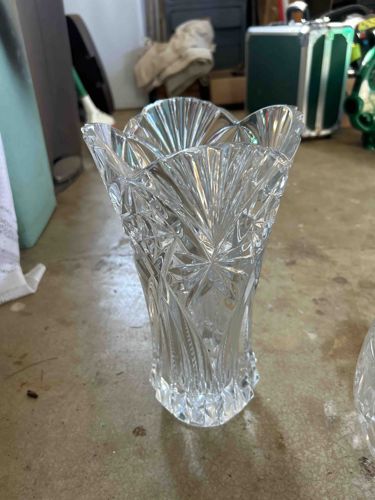
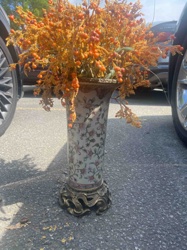
This item is a clear, colorless cut glass vase, likely intended for floral arrangements. Its physical characteristics include a flaring, scalloped rim and a cylindrical body that tapers slightly towards a solid, hexagonal base. The vase is crafted from thick glass, exhibiting a high degree of transparency and brilliance, indicative of lead crystal or a high-quality glass formulation designed to mimic crystal. The entire surface, from the rim down to the base, is adorned with intricate cut patterns. The upper portion features vertical fluting that transitions into a series of starburst or pinwheel cuts, interspersed with diamond-cut elements and crisscross patterns that catch and refract light effectively. The base itself is faceted, providing stability and contributing to the overall decorative appeal. There are no immediately visible maker's marks, signatures, or stamps in the provided image. The style suggests it could be a piece from the late 19th to mid-20th century, a period when cut glass was very popular, or a more contemporary reproduction. There do not appear to be any significant condition issues such as chips, cracks, or repairs visible in the images; the glass appears clean and free of significant scratches or clouding. The craftsmanship, particularly the precision of the cuts and the polished facets, indicates a reasonably good quality production, typical of decorative glassware designed to enhance the beauty of flowers. The lack of coloration or etching suggests a focus on the natural sparkle and light-refracting properties of the clear glass.
AI Appraisal Report
I have examined the provided image of this clear, colorless cut glass floral vase. Visually, the vase appears to be in very good condition, showing no obvious chips, cracks, or significant clouding. The thickness and brilliance of the glass, coupled with the intricate fluting, starburst, diamond, and crisscross cut patterns, suggest a good quality production. The faceted hexagonal base adds to its stability and aesthetic appeal.
Authenticity, based solely on visual examination of the image, places this piece within the broad category of decorative cut glass manufactured from the late 19th through the mid-20th century, or even a more modern reproduction. Without physical inspection, identifying the exact manufacturer or period is challenging. The absence of maker's marks is common for many pieces from this era, but also for reproductions. Market conditions for unidentifiable cut glass vases are generally modest. While beautifully crafted, these items are not exceptionally rare, and demand for unmarked pieces, even of good quality, is not as high as for those by acclaimed makers like Hawkes, Libbey, or Dorflinger. Comparables typically sell in the $50-$200 range, depending on size, complexity of cuts, and condition.
Factors impacting value positively include the apparent pristine condition and the detailed, precise cutting. The lack of a definitive maker or period, however, limits its upper value. For full authentication and a more precise valuation, I would require an in-person examination to assess the glass's lead content (e.g., using a refractometer), detect microscopic wear patterns, and search for faint acid-etched marks. Provenance documentation, if available, would also significantly enhance authenticity and value. Without these, it remains a lovely decorative item of good quality.